Stripe alternatives for SaaS: Paddle, Lemon Squeezy, Polar and more
Stripe alternatives for SaaS founders and indie makers: payment processor vs merchant of record, Paddle, Lemon Squeezy, Polar and Chargebee compared, a decision guide and mistakes to avoid.

Stripe is the default payment stack for most new SaaS products, and for good reason: the API is excellent and the docs are some of the best in software. But it is not always the right first choice. If you sell worldwide as a solo founder, sales tax and VAT can become a second job. If you sell digital products, a merchant of record may save you weeks. This guide compares the main Stripe alternatives for SaaS and indie makers, and explains when switching actually makes sense.
In this article8
Why founders look for Stripe alternatives
The reasons are usually practical, not about price alone:
- Tax compliance. With Stripe you are the seller. You collect and remit VAT, GST and US sales tax yourself, even if Stripe Tax helps you calculate it.
- Country availability. Stripe is not available to businesses in every country, so some founders cannot open an account at all.
- Account reviews and holds. New accounts with sudden volume, such as a launch day spike, sometimes see payouts held for review.
- Time. Billing logic, dunning, invoices, refunds and tax reports all take engineering time that a small team may not have.
Before you compare tools, decide one thing: do you want to be the merchant, or do you want someone else to be the merchant for you?
Payment processor vs merchant of record
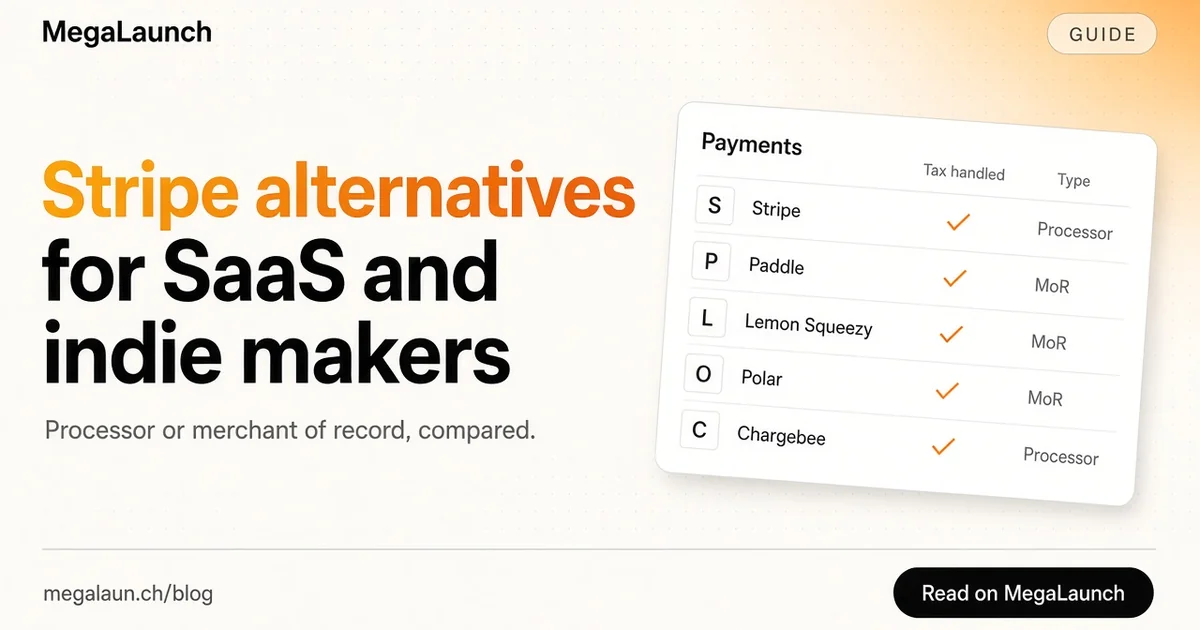
A payment processor like Stripe moves the money. You are the legal seller, so taxes, invoices and chargebacks are your responsibility.
A merchant of record (MoR) resells your product to the customer. It charges them, handles VAT and sales tax in each country, issues the invoice and pays you the rest. You lose some control and pay a higher fee, but you remove most of the tax paperwork.
For a solo founder selling a $19 per month plan to customers in 40 countries, an MoR is often the simplest option. For a funded team with an accountant and custom billing needs, a processor is usually better.
The main Stripe alternatives
1. Paddle
Paddle is the best-known merchant of record for SaaS. It handles subscriptions, checkout, tax, invoices and many payment methods. Its public pricing is 5% + 50¢ per transaction, with no monthly fee, which includes the tax work. Paddle reviews your business before you can sell, so apply a few weeks before your launch date.
Best for: B2B and B2C SaaS that sells worldwide and does not want to manage sales tax.
2. Lemon Squeezy
Lemon Squeezy is a merchant of record built for digital products, software and subscriptions, with a simple storefront, license keys and an affiliate program. Its listed fee is also 5% + 50¢. Lemon Squeezy was acquired by Stripe in 2024, so check its current roadmap before you commit a new product to it.
Best for: indie makers selling templates, ebooks, desktop apps or small SaaS plans.
3. Polar
Polar is a newer merchant of record aimed at developers. It focuses on subscriptions, one-time purchases, license keys and usage-based billing, with an API and SDKs that feel familiar to developers. It is popular with open source maintainers and developer tool makers.
Best for: developer tools, APIs and open source projects that want to charge for a paid tier.
4. Chargebee
Chargebee is not a processor. It is a subscription billing layer that sits on top of gateways such as Stripe, Braintree or Adyen. It handles plans, trials, coupons, invoices, dunning and revenue reports, so you can switch or combine gateways later.
Best for: growing SaaS teams with complex plans who want billing logic outside their payment gateway.
5. Stay on Stripe, but use more of it
Sometimes the best alternative to Stripe is a better Stripe setup. Stripe's pricing page lists add-ons like Billing, Tax and Radar. Hosted Checkout and the customer portal remove most custom billing code. If your problem is engineering time rather than tax, this is often the fastest fix.
How to choose: a quick decision guide
Answer these questions in order:
- Can you open a Stripe account in your country? If not, a merchant of record such as Paddle, Lemon Squeezy or Polar may be the way to accept card payments.
- Do you want to file sales tax and VAT yourself? If not, pick an MoR.
- Is your price low and your audience global? An MoR fee of around 5% is usually cheaper than an accountant plus tax registrations in several countries.
- Do you need custom billing, such as seats, usage and annual contracts? A processor plus a billing layer like Chargebee gives you more control.
- Will you sell to enterprises that ask for invoices and purchase orders? Check that the tool supports invoices, bank transfers and tax IDs.
What to compare before you switch
Fees matter, but they are rarely the deciding factor. Compare these instead:
- Who is the seller on the customer's receipt and bank statement.
- Payout schedule and minimum payout amounts.
- Payment methods in your main markets, such as cards, PayPal, Apple Pay or local methods.
- Subscription features: trials, proration, upgrades, coupons, dunning emails.
- Data portability. Can you export customer and card data if you leave? Moving saved cards between providers usually needs a formal migration process, so ask before you sign.
- Approval process. Merchants of record review your product and website first. A clear pricing page, terms, privacy policy and refund policy speed this up.
If you are still deciding how to price, read SaaS pricing models first, then design the page with these pricing page examples.
Common mistakes
- Choosing on the headline fee. A 2% saving disappears the first time you have to register for VAT in a new region.
- Setting up payments the week of launch. MoR approvals and account reviews take time. Start at least two weeks before you go live.
- Hard-coding the provider everywhere. Keep payment logic behind one small module and listen to webhooks, so a future switch is a project, not a rewrite.
- Forgetting one-time deals. If you plan a lifetime deal, check that your provider supports one-time payments and license keys alongside subscriptions.
Summary
Stripe is a payment processor: flexible, powerful, and you are the seller. Paddle, Lemon Squeezy and Polar are merchants of record that take on tax and invoicing for a higher fee. Chargebee adds a billing layer on top of a gateway. Solo founders selling globally usually move faster with a merchant of record, while teams with complex billing usually stay on a processor. Pick one, set it up before launch day, and when your checkout is ready, list your product on MegaLaunch to get your first paying users.
Frequently asked questions
What is the best Stripe alternative for SaaS?
For solo founders selling worldwide, a merchant of record such as Paddle or Lemon Squeezy is often the simplest because it handles sales tax and VAT. For teams with complex billing, Stripe plus a billing layer like Chargebee gives more control.
What is a merchant of record?
A company that legally resells your product to the customer. It charges the customer, collects and remits sales tax and VAT, issues invoices and pays you the remainder.
Is Paddle more expensive than Stripe?
Paddle lists 5% + 50 cents per transaction, which is higher than a processor fee, but it includes tax compliance and invoicing that you would otherwise handle yourself.
Can I switch payment providers later?
Yes, but moving saved cards and active subscriptions needs a migration process. Keeping payment logic in one module and relying on webhooks makes the switch much easier.
Sources
 @matthias_mrc
Put it into practice. Launch your product.
A permanent page, a followed link to your site, and makers who vote for what they like.
- Free with a link back to MegaLaunch
- Premium: $14.99 one-time, no backlink needed
Done for you
We submit your product to 100+ dofollow directories.
From one brief, with a report for every directory. No badge needed on your site.


From$99one-time
See the plans