Startup valuation calculator: 5 methods for early-stage founders
How to estimate an early-stage startup valuation: pre-money and post-money math, revenue multiples, the Berkus, scorecard and VC methods, DCF, and how to build a valuation calculator in a spreadsheet.

A startup valuation calculator gives you a defensible range for what your company is worth before you talk to investors or set a cap on a SAFE. There is no single correct number for an early startup: valuation is a negotiation, and the methods below give you anchors for that negotiation. This guide covers the common methods, the math behind pre-money and post-money valuation, and how to build a simple calculator in a spreadsheet.
In this article11
Why early-stage valuation is hard
Classic valuation relies on cash flows, profits and comparable companies. A pre-revenue startup has none of those. Investors are pricing risk and potential: the team, the market, early traction and how much money is needed to reach the next milestone. That is why early valuations vary so much between companies that look similar on paper.
Use several methods, compare the results and treat the overlap as your working range.
Pre-money and post-money valuation
Before any method, get the basic math right.
- Pre-money valuation: the value of the company just before new money comes in.
- Post-money valuation: pre-money plus the new investment.
- Investor ownership = investment ÷ post-money valuation.
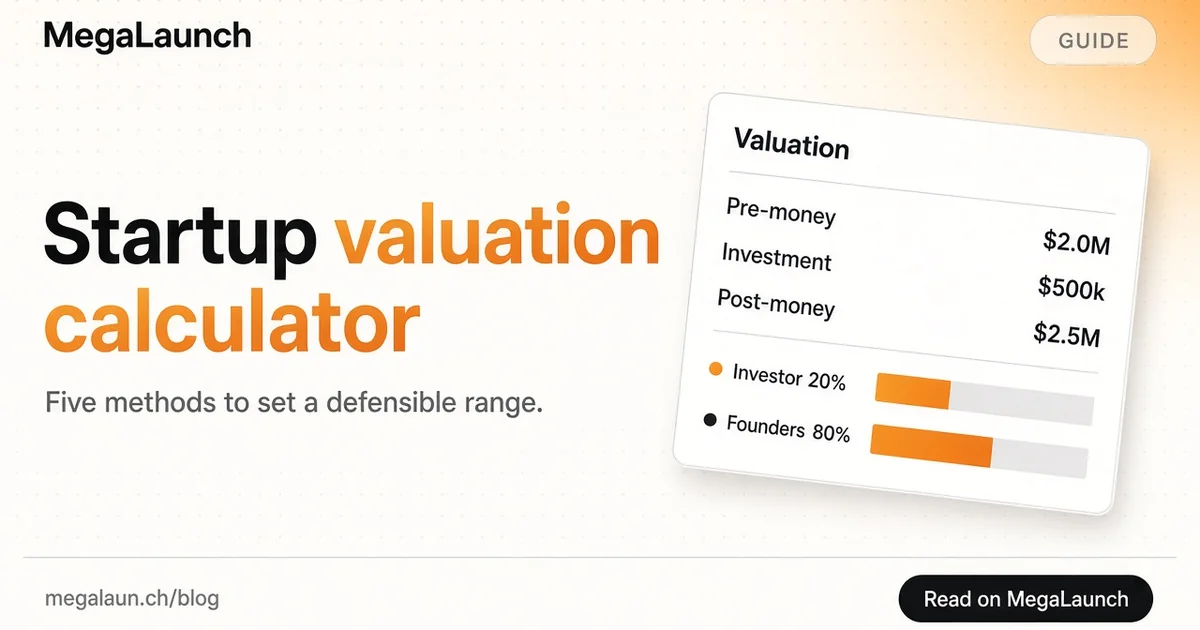
Example: an investor puts in $500,000 at a $2,000,000 pre-money valuation. Post-money is $2,500,000 and the investor owns 500,000 ÷ 2,500,000 = 20%. Your existing shareholders own the remaining 80% together.
Many early rounds use a SAFE instead of priced equity. The SAFE has a valuation cap rather than a price, but the same logic applies: the cap works like a maximum post-money (or pre-money, depending on the version) valuation. Y Combinator publishes its standard SAFE documents if you want to read the exact terms.
Method 1: revenue multiple
If you have recurring revenue, the most common shortcut is:
Valuation = ARR × multiple
The multiple depends on growth, churn, margins, market size and the current funding climate. With $300,000 ARR and a multiple of 4, the estimate is $1,200,000. Change the multiple to 6 and it becomes $1,800,000, which shows how sensitive this method is. Calculate ARR carefully first; our ARR calculator explains how.
Use multiples from recent, comparable deals or acquisition marketplaces in your niche, not from headlines about large public companies.
Method 2: Berkus method
Designed for pre-revenue startups, the Berkus method assigns up to a fixed amount (often $500,000) to each of five risk areas:
- Sound idea (basic value and product risk)
- Prototype (technology risk)
- Quality of the management team (execution risk)
- Strategic relationships (market risk)
- Product rollout or first sales (production risk)
You score each area from zero to the maximum and add them up. A team with a working prototype and a strong founder but no partners or sales might score $500k + $400k + $450k + $0 + $100k = $1,450,000.
Method 3: scorecard method
The scorecard method starts from the average pre-money valuation of comparable funded startups in your region and stage, then adjusts it. Typical weights are:
| Factor | Weight |
|---|---|
| Strength of the team | 30% |
| Size of the opportunity | 25% |
| Product or technology | 15% |
| Competitive environment | 10% |
| Marketing, sales and partnerships | 10% |
| Need for additional investment | 5% |
| Other factors | 5% |
Rate your startup against the average for each factor (for example 125% if stronger, 75% if weaker), multiply by the weight and add the results. If the total is 1.10 and the regional average is $2,000,000, your estimate is $2,200,000.
Method 4: venture capital method
This method works backwards from an exit, the way a venture capital fund thinks:
- Estimate the company's value at exit, for example in 7 years.
- Divide by the return multiple the investor targets to get post-money today.
- Subtract the investment to get pre-money.
Example: expected exit value $30,000,000, target return 10x, investment $500,000. Post-money = 30,000,000 ÷ 10 = $3,000,000. Pre-money = $2,500,000. Real investors also account for dilution from later rounds, which lowers the number.
Method 5: discounted cash flow
Discounted cash flow projects future cash flows and discounts them back to today with a rate that reflects risk. It is standard for mature companies, but for a startup the result depends almost entirely on assumptions you cannot verify. Use it as a sanity check once you have a few years of revenue history, not as your main number.
Build a startup valuation calculator in a spreadsheet
Create one tab per method and a summary tab:
- Inputs tab: ARR, growth rate, monthly burn, investment amount, comparable average pre-money, expected exit value, target return multiple.
- Revenue multiple tab: ARR × low, mid and high multiples.
- Berkus tab: five rows with a score and a maximum per row.
- Scorecard tab: factor, weight, your rating, weighted score.
- VC method tab: exit value ÷ target return − investment.
- Summary tab: each method's result, the minimum, the maximum and the median, plus a dilution table showing ownership after the round.
Showing a range instead of one number is more credible, and it helps you decide what you can accept before the conversation starts.
Common mistakes
- Anchoring on one famous deal. Outliers are reported because they are rare.
- Ignoring dilution. Option pools and future rounds reduce everyone's share.
- Raising more than you need. A higher valuation with too much money can make the next round harder if growth does not follow. Check your burn rate and raise for a clear milestone.
- Treating the cap as the goal. Terms, investor quality and speed often matter more than a slightly higher number.
Before you talk to investors
Valuation follows evidence. Traction from a public launch, paying customers and a clear story in your pitch deck move the range more than any formula. Launching on MegaLaunch and other platforms is a cheap way to collect that first proof before you set your number.
Frequently asked questions
How do you calculate a startup valuation?
Use several methods and compare them: a revenue multiple if you have ARR, the Berkus or scorecard method before revenue, and the VC method based on a future exit. The overlap of the results is your working range.
What is the difference between pre-money and post-money valuation?
Pre-money is the value before new investment; post-money is pre-money plus the investment. Investor ownership equals the investment divided by the post-money valuation.
How do you value a pre-revenue startup?
Methods like Berkus and scorecard rate the idea, prototype, team, market and partnerships, or compare you with the average valuation of similar funded startups in your region.
Is a higher valuation always better?
No. A valuation that growth does not justify can make the next round harder. Terms, investor quality and raising enough for a clear milestone often matter more.
Sources
 @matthias_mrc
Put it into practice. Launch your product.
A permanent page, a followed link to your site, and makers who vote for what they like.
- Free with a link back to MegaLaunch
- Premium: $14.99 one-time, no backlink needed
Done for you
We submit your product to 100+ dofollow directories.
From one brief, with a report for every directory. No badge needed on your site.


From$99one-time
See the plans