ARR calculator: how to calculate annual recurring revenue
How to calculate ARR from MRR, handle annual plans, discounts and one-off fees, track new, expansion and churned MRR, and report ARR to investors, with a spreadsheet calculator.

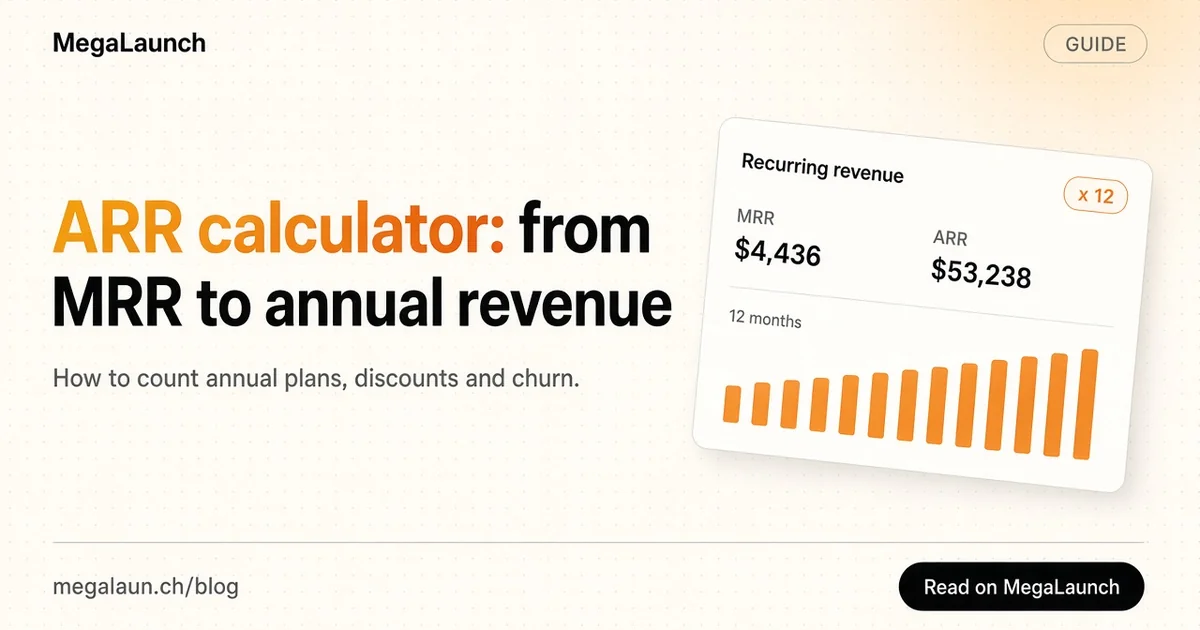
Annual recurring revenue (ARR) is the yearly value of the subscriptions you have right now. It is the headline number investors, acquirers and other founders use to size a SaaS business, and it is easy to get wrong. This guide shows how to calculate ARR from MRR, how to handle annual plans, discounts and one-off fees, and how to track the movements behind the number with a simple calculator.
In this article10
What ARR is
Annual recurring revenue is the annualized value of recurring subscription contracts. It is a metric built for software as a service and other subscription businesses, where revenue repeats each month or year until the customer cancels.
ARR is a snapshot, not a total. It answers: if nothing changed from today, how much recurring revenue would we collect over the next 12 months?
The ARR formula
The simplest and most common formula is:
ARR = MRR x 12
MRR (monthly recurring revenue) is the sum of what all active paying customers pay per month, normalized to a monthly amount. So the real work is calculating MRR correctly.
How to calculate MRR
For each active subscription, convert the price to a monthly amount and add them up:
- Monthly plans: the monthly price, after any recurring discount.
- Annual plans: the annual price divided by 12.
- Quarterly plans: the quarterly price divided by 3.
- Usage-based charges: only include a committed minimum, or a stable average if you can justify it.
Do not include:
- One-time fees such as setup, onboarding or a lifetime deal.
- Free trials that have not converted.
- Customers who have cancelled, even if their access lasts until the end of the period.
- Taxes such as VAT.
A simple ARR calculator
Rebuild this in a spreadsheet:
| Line | Customers | Price | Monthly value |
|---|---|---|---|
| Monthly plan | 120 | $29 / month | $3,480 |
| Annual plan | 15 | $290 / year | $362.50 |
| Team plan | 6 | $99 / month | $594 |
| MRR | $4,436.50 | ||
| ARR = MRR x 12 | $53,238 |
These are example numbers. Notice that the annual plan counts as $290 / 12 = $24.17 per customer per month, not $290 in the month it was paid. ARR is about recurring value, not cash received.
ARR is not revenue or cash
Founders often mix up three numbers:
- Cash collected: what landed in the bank this month. An annual plan brings 12 months of cash on day one.
- Recognized revenue: what your accountant books. Under revenue recognition rules, an annual subscription is spread over the 12 months it covers.
- ARR: a forward-looking operating metric. It is not an accounting figure and does not appear in financial statements.
Use cash for runway, recognized revenue for accounts and taxes, and ARR to measure growth.
Track the movements behind ARR
The total hides what is happening. Break each month's change in MRR into four parts:
- New MRR: from customers who started paying this month.
- Expansion MRR: upgrades, extra seats, add-ons.
- Contraction MRR: downgrades and new recurring discounts.
- Churned MRR: from customers who cancelled.
Ending MRR = starting MRR + new + expansion - contraction - churned
Example: you start the month at $10,000 MRR, add $1,200 new, $300 expansion, lose $150 to downgrades and $400 to cancellations. Ending MRR is $10,950, so ARR goes from $120,000 to $131,400.
From the same numbers you get two useful ratios:
- Monthly growth rate: (10,950 - 10,000) / 10,000 = 9.5%.
- Net revenue retention (monthly): (10,000 + 300 - 150 - 400) / 10,000 = 97.5%. It shows what your existing customers are worth a month later, without new sales. Above 100% means expansion outweighs churn.
Common ARR mistakes
- Counting lifetime deals or setup fees. They are one-off. Report them separately.
- Annualizing a great month. If a launch brought a spike of monthly signups, wait to see how many renew before you quote ARR.
- Including trials or unpaid invoices. Only count customers who are actually paying.
- Keeping cancelled customers until their period ends. Remove them from MRR when they cancel, or report a separate committed figure.
- Mixing currencies loosely. Convert at a fixed rate each month so exchange rate swings do not look like growth.
- Calling run-rate ARR. Revenue run rate annualizes all revenue, including one-off and usage. ARR should contain recurring revenue only. Say which one you mean.
Benchmarks worth knowing
Benchmarks vary a lot by market and stage, so treat these as orientation, not targets:
- Early stage: what matters most is consistent month-over-month MRR growth and low early churn. Going from $0 to the first $1,000 MRR is often the hardest step.
- Ramen profitability: the point where MRR covers the founders' basic living costs. It gives you time to keep building without raising money.
- Rule of 40: for more mature SaaS companies, the Rule of 40 says growth rate plus profit margin should be at least 40%. It is rarely meaningful below a few million in ARR.
How to report ARR to investors and buyers
When you share ARR in a pitch deck, update or acquisition listing, add context so the number is trusted:
- State the date: "ARR of $53k as of 31 October".
- Show the MRR chart for the last 12 months, not just today's figure.
- Show the split between new, expansion, contraction and churn.
- Say how annual plans and discounts are treated.
- Give customer count and ARPA so readers can sanity-check the total.
If you are preparing a deck, our pitch deck template shows where traction metrics fit.
How to grow ARR
ARR grows in only a few ways: more customers, higher prices, more expansion and less churn.
- Win more customers by putting your product where buyers discover software: launch platforms, directories, communities and search.
- Price for value, with a higher tier or usage limit that grows with the customer. Our guide to SaaS pricing models covers the options.
- Push annual plans to reduce churn and bring cash forward.
- Fix failed payments with card retries and reminder emails.
Recalculate MRR and ARR on the same day each month, with the same rules. Consistency matters more than any single figure.
Frequently asked questions
How do you calculate ARR?
Multiply monthly recurring revenue by 12. MRR is the sum of what all active paying customers pay per month, with annual plans divided by 12 and one-off fees excluded.
Do annual plans count fully in the month they are paid?
No. For MRR and ARR an annual plan counts as its yearly price divided by 12 each month. The full payment matters for cash and runway, not for ARR.
Should lifetime deals or setup fees be included in ARR?
No. They are one-off payments, not recurring revenue. Report them separately so ARR stays comparable.
What is the difference between ARR and revenue run rate?
ARR only includes recurring subscription revenue. Revenue run rate annualizes all revenue in a period, including one-off and usage revenue, so it is usually higher and less stable.
Sources
 @matthias_mrc
Put it into practice. Launch your product.
A permanent page, a followed link to your site, and makers who vote for what they like.
- Free with a link back to MegaLaunch
- Premium: $14.99 one-time, no backlink needed
Done for you
We submit your product to 100+ dofollow directories.
From one brief, with a report for every directory. No badge needed on your site.


From$99one-time
See the plans