Burn rate calculator: how to work out your startup runway
How to calculate gross and net burn rate and runway, a simple spreadsheet calculator with a worked example, healthy benchmarks and ways to extend runway.

Burn rate is the speed at which your startup spends cash. Runway is how many months that cash lasts. Together they answer the most important question a founder can ask: how long do we have before the money runs out? You do not need a finance degree or a paid tool to work them out. This guide gives you the burn rate formulas, a simple calculator you can rebuild in a spreadsheet, worked examples and practical ways to extend your runway.
In this article10
What burn rate means
Burn rate is the amount of money a company loses each month, usually measured before it becomes profitable. It is a cash flow measure, not an accounting one. What matters is cash leaving the bank account, not revenue booked or expenses on paper.
There are two versions, and you need both:
- Gross burn is everything you spend in a month: salaries, contractors, hosting, software, ads, rent, taxes and fees.
- Net burn is gross burn minus the cash that comes in from customers that month. It is the number that actually shrinks your bank balance.
A bootstrapped SaaS with $4,000 in monthly revenue and $10,000 in monthly spending has a gross burn of $10,000 and a net burn of $6,000.
The burn rate formulas
You can calculate everything with four lines:
- Gross burn = total cash spent in the month
- Net burn = cash spent in the month - cash received in the month
- Average net burn = (cash balance three months ago - cash balance today) / 3
- Runway (months) = cash in the bank / average net burn
Use an average of the last three months rather than a single month. Annual software renewals, a conference trip or a big customer paying a yearly invoice can make one month look much better or worse than reality.
A simple burn rate calculator
You can build a reliable calculator in any spreadsheet with five inputs:
| Input | Example |
|---|---|
| Cash in the bank today | $90,000 |
| Monthly operating expenses | $14,000 |
| Monthly revenue collected | $5,000 |
| Expected monthly revenue growth | 6 percent |
| Planned one-off costs in the next 12 months | $6,000 |
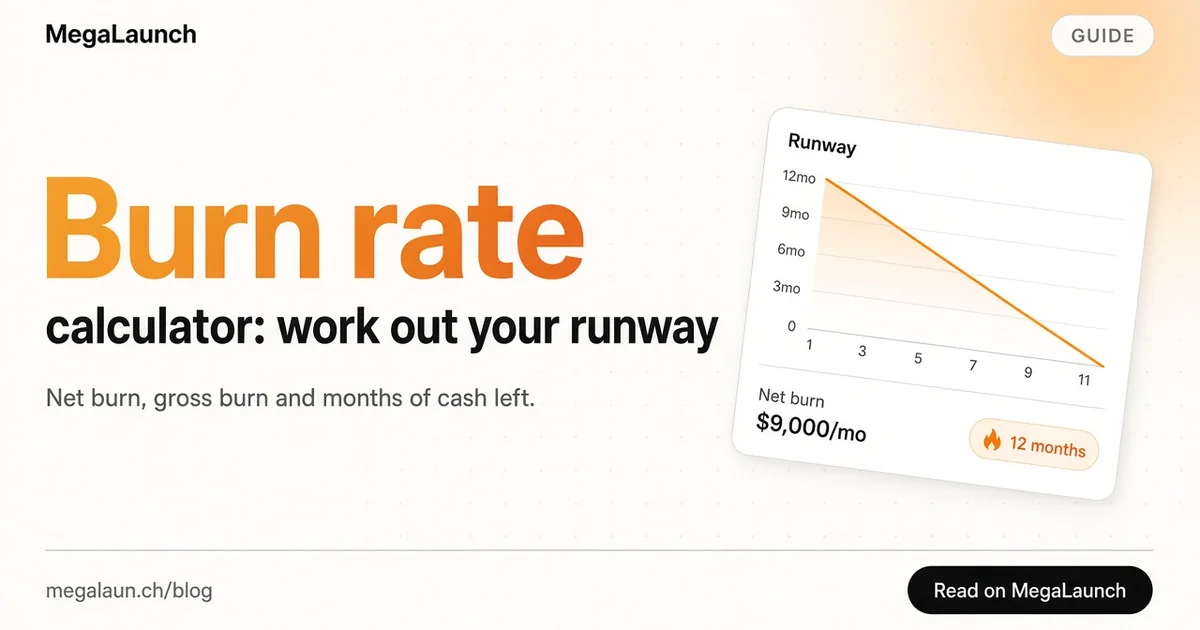
With these example numbers, net burn is $14,000 - $5,000 = $9,000 a month, and the simple runway is $90,000 / $9,000 = 10 months.
The simple runway assumes nothing changes. A better calculator projects month by month: revenue grows by your expected rate, costs stay flat or grow with hiring, one-off costs land in the right month, and the cash balance carries over. In the example above, 6 percent monthly revenue growth stretches the runway to about 12 months, even after the $6,000 of one-off costs, because net burn falls a little every month. Build both views and plan with the more pessimistic one.
These numbers are illustrations only. Replace them with your own bank data, not your forecast.
Default alive or default dead
Paul Graham's essay Default Alive or Default Dead? turns burn rate into a single question: if your expenses stay as planned and revenue keeps growing at its recent rate, will you reach profitability before the money runs out?
Your projected calculator answers it. If the month where revenue crosses expenses comes before the month where cash hits zero, you are default alive. If not, you are default dead, and you need to change something now, not in the last three months of runway.
For many indie makers the realistic goal is to be ramen profitable: revenue that covers the founders' basic living costs. It removes the deadline entirely and gives you time to keep building.
What counts as a healthy burn rate
There is no universal good number, but these rules of thumb are widely used:
- Keep at least 12 months of runway when things are calm, and more if you plan to raise money. Fundraising often takes several months, and investors notice when you are short of cash.
- Start acting when runway drops below 6 months. Cutting costs or raising takes time to show up in the bank.
- Watch burn per new dollar of revenue. If net burn rises by $5,000 a month, monthly revenue should grow meaningfully over the following quarter. Spending that buys no growth is the most expensive kind.
- Track gross margin. Hosting, AI tokens and payment fees grow with usage. A product with thin margins burns more as it grows, not less.
How to reduce burn rate without stalling growth
Start with the costs that bring nothing back:
- Audit software subscriptions. List every tool on your card statements and cancel duplicates and unused seats.
- Review infrastructure. Oversized databases, idle servers and expensive API calls are common in early products.
- Move to annual plans for customers. Offering a discount for yearly payment brings cash forward and lowers net burn immediately. Our guide to SaaS pricing models covers how to structure them.
- Pause paid channels that cannot prove results. Keep channels where you can measure customer acquisition cost and payback.
- Delay hires, not revenue work. Hiring is the biggest burn decision. Make sure the role produces revenue or saves founder time on revenue work.
- Collect faster. Invoice on time, chase late payments and use automatic card billing where possible.
Some founders sell a lifetime deal to bring in cash quickly. It can help, but read the trade-offs first, because it also reduces future revenue.
Extending runway with outside money
If cutting is not enough, you can add cash:
- Revenue-based financing, repaid as a share of future revenue.
- Grants and public innovation programs, common in Europe for early tech companies.
- Venture debt, usually available only after an equity round.
- An equity round, if the business can grow fast enough to justify it. A clear pitch deck with your burn, runway and growth assumptions makes that conversation easier.
Each of these has a cost. Debt must be repaid, and equity dilutes ownership. Raise because you have a plan for the money, not only to buy time.
Make burn rate a monthly habit
The most useful thing you can do is check the numbers every month on a fixed date:
- update the cash balance from the bank, not from your accounting tool's forecast
- recalculate the three-month average net burn
- update runway and the default alive date
- write one sentence on what changed and why
It takes 20 minutes and stops the most common startup failure: running out of money without seeing it coming.
The bottom line
Burn rate tells you how fast cash leaves; runway tells you how long it lasts. Calculate gross and net burn, average over three months, project month by month, and act early when runway falls under six months. Growing revenue is the best way to lower burn, and a launch is one of the cheapest ways to find new customers: you can list your product on MegaLaunch to put it in front of makers and early adopters.
Frequently asked questions
How do you calculate burn rate?
Gross burn is the total cash you spend in a month. Net burn is that amount minus the cash you receive from customers. For a stable figure, take your cash balance three months ago, subtract today's balance and divide by three.
How do you calculate runway from burn rate?
Divide the cash in your bank account by your average monthly net burn. With $90,000 in the bank and a net burn of $9,000 a month, runway is 10 months, before counting revenue growth.
What is a good burn rate for a startup?
There is no single number. What matters is runway and what the spending buys. A common rule is to keep at least 12 months of runway and to start cutting costs or raising money when it falls below 6 months.
What is the difference between gross burn and net burn?
Gross burn counts all money going out each month. Net burn subtracts the revenue coming in, so it shows how fast your bank balance actually shrinks.
Sources
 @matthias_mrc
Put it into practice. Launch your product.
A permanent page, a followed link to your site, and makers who vote for what they like.
- Free with a link back to MegaLaunch
- Premium: $14.99 one-time, no backlink needed
Done for you
We submit your product to 100+ dofollow directories.
From one brief, with a report for every directory. No badge needed on your site.


From$99one-time
See the plans