Pitch deck template: 12 slides investors expect
A slide-by-slide pitch deck template for early-stage founders: what goes on each of the 12 slides, design rules that keep it readable, and mistakes to avoid.

A pitch deck is a short slide presentation that explains your startup to investors: the problem, your solution, why now, and why your team can win. Most first-time founders spend too long on design and too little on the story. This guide gives you a slide-by-slide pitch deck template you can copy into Google Slides, Keynote or Figma today, plus the rules that keep it readable.
In this article7
What a pitch deck is for
A pitch deck has two jobs. First, it gets you a meeting: an investor skims it in a few minutes and decides whether to talk to you. Second, it supports the meeting itself, where you present it live. The same file rarely does both jobs well, so plan for two versions:
- a send-ahead deck that reads on its own, with full sentences on each slide
- a presenting deck with fewer words, where you do the talking
Start with the send-ahead version. If a stranger can understand your company from it alone, the live version is easy to trim.
The pitch deck template, slide by slide
This order follows the structure Sequoia recommends in Writing a Business Plan, adapted for an early-stage product. Each slide gets one headline sentence that states the point, not a label like "Problem".
1. Title
Company name, a one-line description of what you do, your name and an email. The one-liner should say who it is for and what it does: "Invoicing for freelance designers that gets them paid in days, not weeks."
2. Problem
Describe the pain of one specific customer. Use a short story or one hard number from your own research. Avoid market-wide claims you cannot back up.
3. Solution
Show how your product removes that pain. A screenshot beats a paragraph. Keep it to the core workflow, not every feature.
4. Why now
What changed that makes this possible or urgent today: a new technology, a regulation, a shift in behavior. Investors ask this even when it is not on the slide, so answer it up front.
5. Market
Who buys, how many of them exist and what they pay. A bottom-up estimate (number of target customers times your price) is more credible than a top-down "1% of a $50B market".
6. Product
Two or three screenshots or a short demo flow. If you have a live product, put the link in the send-ahead version.
7. Traction
Your strongest real numbers: users, revenue, growth rate, retention, waitlist size, pilot customers. Put the best one in the headline. If you are pre-launch, show learning instead: interviews done, letters of intent, signups from a coming soon page.
8. Business model
How you make money and roughly how much per customer. If you are still deciding, our guide to SaaS pricing models helps you pick a starting point.
9. Competition
Name the real alternatives, including spreadsheets and doing nothing. A simple table of what each option does well and badly is clearer than a two-by-two chart where you sit alone in the top right corner.
10. Go-to-market
How you will reach your first 100 and then 1,000 customers: channels, launch plan, partnerships. Be concrete about the first channel you have already tested.
11. Team
Founders, the relevant experience of each, and why this team fits this problem. Two or three lines per person is enough.
12. The ask
How much you are raising, what it pays for and what milestones it gets you to in 18 to 24 months.
That is twelve slides. If you need fewer, merge Product into Solution and Go-to-market into Business model.
Rules that keep a deck readable
Guy Kawasaki's 10/20/30 rule is still a good default for the presenting version: ten slides, twenty minutes, and no font smaller than thirty points. The font rule matters most. It forces you to cut text until only the point is left.
Y Combinator's Kevin Hale makes a similar case in How to Design a Better Pitch Deck: slides should be legible, simple and obvious, so someone at the back of the room gets each one in a glance. In practice:
- one idea per slide, stated in the headline
- large text, high contrast, no paragraphs on the presenting deck
- real numbers with units and dates, never "lots of users"
- the same font, colors and layout on every slide
For a seed round specifically, YC's guide on how to build your seed round pitch deck is worth reading before your first meeting.
How to fill in the template in one afternoon
- Write the headlines first. Twelve sentences, one per slide, in a plain document. Read them in order. If they tell the whole story, the deck works.
- Add one piece of evidence per slide. A number, a screenshot, a quote from a customer interview.
- Only then open the slide tool. Use a blank, simple theme. Design should make the headline easy to read, nothing more.
- Test it on two people who do not know your company. Ask them to explain the business back to you. Fix every slide where they hesitate.
- Export a PDF for the send-ahead version and name it clearly, for example
megalaunch-seed-deck-2026.pdf.
Common mistakes
- Starting with the market size. Investors care about the problem first. A big number with no pain behind it is not a company.
- Hiding traction at the end. If you have strong numbers, move the Traction slide up to position three.
- Too many slides. Over twenty slides usually means you have not decided what matters.
- Vague asks. "Raising a seed round" is not an ask. "Raising $750k to reach $40k MRR in 18 months" is.
Before you send it
A deck does not replace fundraising basics. Paul Graham's essay How to Raise Money explains how investors decide and why momentum matters more than slides. Work on the company, then let the deck describe it. Your startup one pager can follow the same structure for people who want a single page instead of slides.
If you have launched, add your launch results to the Traction slide. A product page on MegaLaunch with real upvotes and comments is simple, verifiable proof that people want what you built.
Frequently asked questions
How many slides should a pitch deck have?
Ten to fifteen slides is the usual range. Guy Kawasaki recommends ten slides for a live pitch. A send-ahead deck can run a little longer because it has to read without you.
What slides go in a startup pitch deck?
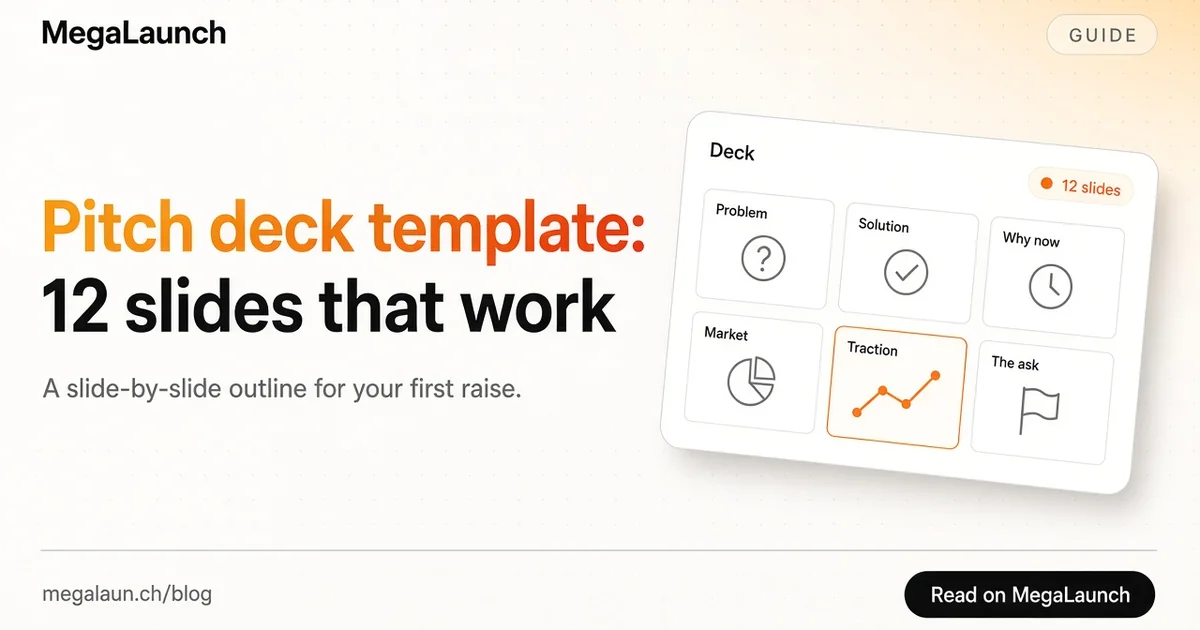
A common order is title, problem, solution, why now, market, product, traction, business model, competition, go-to-market, team and the ask.
Should I send my pitch deck before the meeting?
Yes, if an investor asks for it. Send a version with full sentences that explains the company on its own, and keep a lighter version with less text for presenting live.
What tool should I use to make a pitch deck?
Google Slides, Keynote, PowerPoint or Figma all work. The tool matters far less than clear headlines, real numbers and a simple, consistent layout.
Sources
 @matthias_mrc
Put it into practice. Launch your product.
A permanent page, a followed link to your site, and makers who vote for what they like.
- Free with a link back to MegaLaunch
- Premium: $9.99 one-time, no backlink needed
Done for you
We submit your product to 100+ dofollow directories.
From one brief, with a report for every directory. No badge needed on your site.


From$99one-time
See the plans