Startup one pager: a template you can copy
A startup one pager template with the ten blocks investors, partners and early users look for, a filled example, and the mistakes that get it ignored.

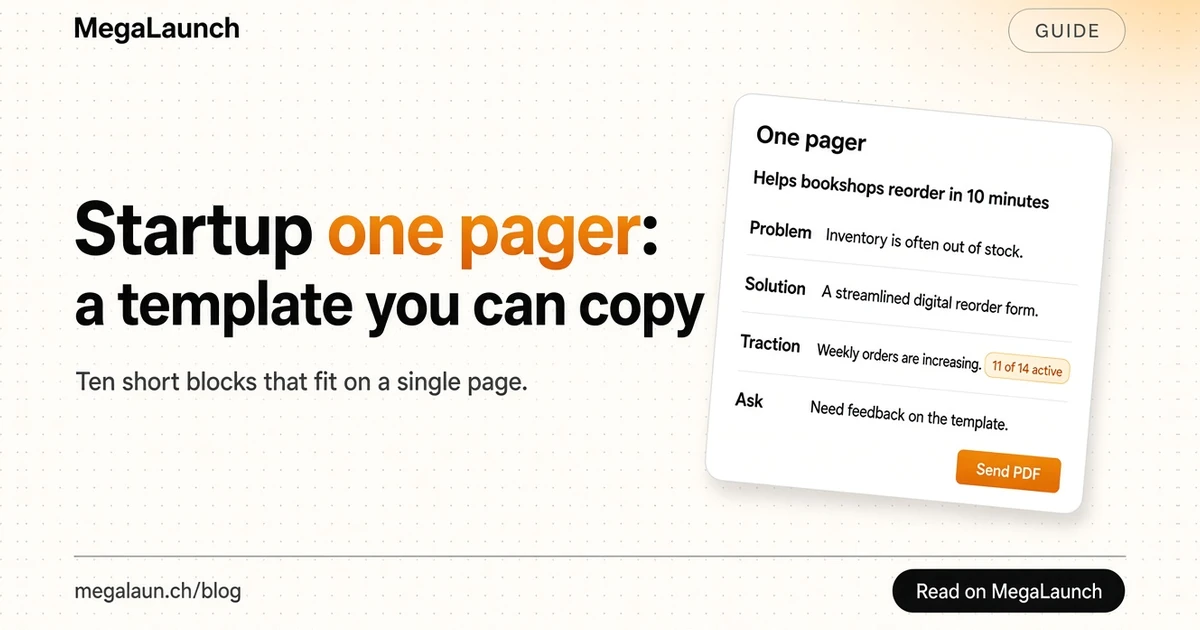
A startup one pager is the page you send when someone says "send me something I can read". It has to explain your company in the two or three minutes a busy person gives an unknown email, and it often gets forwarded to people you never talked to. That makes it harder to write than a pitch deck, and more useful.
This guide gives you a template with ten blocks, a filled example, and the mistakes that get one pagers ignored. Sources were checked on October 27, 2026.
In this article7
What a one pager is for
A one pager has one job: get the reader to the next step. For an investor, that step is a first call. For a partner, a meeting. For a journalist or a newsletter editor, a reply. It is not meant to answer every question, only the questions someone asks before deciding whether you are worth more time.
That is the same role an executive summary plays in a long report: a document in miniature that can be read in place of the longer one. If your reader only reads this page, they should still understand what you do, for whom, and why it is working.
The template: ten blocks
The structure below follows the order Sequoia recommends in its guide to writing a business plan, compressed to fit one page. Aim for one to three sentences per block.
- Company in one sentence. Sequoia calls this the company purpose: "define your company in a single declarative sentence". Say what you make and for whom, not your mission statement.
- Problem. The pain of your customer, how they handle it today, and why current solutions fall short.
- Solution. What your product does about it, described as an outcome, not a feature list.
- Why now. What changed that makes this possible or necessary today: a new technology, a regulation, a shift in behavior.
- Customer and market. Who buys first, and how many people or companies look like them.
- Traction. Users, revenue, growth, pilots, waitlist, or letters of intent. Only real numbers.
- Business model. Who pays, how much, and how often.
- Competition and alternatives. Including spreadsheets and doing nothing, which is often the real competitor.
- Team. Why you are the people to build this, in one line per founder.
- The ask and contact. What you want from the reader, and how to reach you.
You can copy this skeleton as is:
[Company] helps [customer] [do something] without [current pain].

Problem: ...
Solution: ...
Why now: ...
Customer: ...
Traction: ...
Business model: ...
Alternatives: ...
Team: ...
Ask: ... | email | website
If you have ever built a pitch deck, the list will look familiar. Guy Kawasaki's 10/20/30 rule names almost the same ten topics for a deck. The one pager is the same story with no slides and no presenter to fill the gaps.
A filled example
Here is a one pager for an invented product, so you can see the level of detail. The company and numbers are made up for illustration.
Shelfwise helps independent bookshops reorder stock in ten minutes a week instead of an afternoon.
Problem: small bookshops reorder from distributor catalogs by hand, often from memory, and run out of the titles that sell while overstocking the ones that do not. Solution: Shelfwise reads sales from the shop's till and suggests a weekly order the owner approves in one click. Why now: most shops have moved to cloud tills with open APIs. Customer: independent bookshops with one to three locations. Traction: 14 shops in a paid pilot, 11 still active after three months. Business model: monthly subscription per location. Alternatives: distributor portals and spreadsheets. Team: a former bookshop manager and a developer who built inventory tools for retail. Ask: introductions to bookshop associations. founder@example.com
Notice that each block is short, concrete and checkable. A reader can disagree with it, which is a good sign: vague text cannot be wrong, but it cannot convince anyone either.
How to write each block well
Lead with the sentence. Write the first line last, after you have filled in everything else, then rewrite it until a stranger could repeat it. If you struggle, the problem is usually that you have not chosen a first customer yet.
Show evidence, not adjectives. Paul Graham's essay on how to convince investors says they look for three things: formidable founders, a promising market, and usually some evidence of success so far. Your page should make each of those visible with facts, not claims like "huge market" or "passionate team".
Express traction as a rate. A total number of users says little without time. Growth per week or per month tells the reader where you are heading. In Startup = Growth, Graham notes that a good growth rate during Y Combinator is 5 to 7 percent a week. You do not need to hit that, but measuring weekly forces honesty.
Make the business model a sentence, not a canvas. If you have filled in a Business Model Canvas, take the revenue and customer blocks and turn them into one line. The canvas is a thinking tool; the one pager is a communication tool.
Make the ask specific. "We are raising a seed round" is an ask. "Any feedback is welcome" is not. Partners and press need a different ask than investors, so keep one version per audience.
Common mistakes
- Writing for everyone. An investor, a distribution partner and a journalist care about different blocks. Change the order and the ask for each.
- Shrinking the font to fit. If it does not fit at a readable size, cut. A one pager with ten point text is a short business plan, not a one pager.
- Hiding the product. Add one screenshot or a link to a live demo. If the product is live, a public listing works as proof; you can submit it to MegaLaunch and link the page.
- Inventing numbers. Market sizes from a quick search and "projected" users damage trust. Show what you measured and say what you are still testing.
- Forgetting the date. Put the month on the page. Traction numbers expire fast.
Where the one pager fits in your launch
The one pager is often the first written version of your positioning, so it feeds everything that comes after. The same sentences become your landing page headline, your launch announcement and the description on launch platforms. When you prepare those, our go-to-market strategy template turns the customer and channel blocks into a plan, the product launch announcement guide reuses your first sentence, and the free tagline generator helps you compress it further for listings.
Update the page every month. If the first sentence still holds after a few versions, you have found your positioning. If it keeps changing, that is useful information too.
Frequently asked questions
What is a startup one pager?
A startup one pager is a single page that summarizes a company for a busy reader, usually an investor, partner or journalist. It covers what the company does, the problem, the solution, the customer, traction, the business model, the team and what you are asking for, so the reader can decide whether to take a meeting.
What should a startup one pager include?
A one sentence description of the company, the problem, the solution, why now, the target customer, traction or evidence, the business model, competition, the team, and a clear ask with your contact details. Leave out anything the reader does not need to make that first decision.
Is a one pager the same as a pitch deck?
No. A pitch deck supports a conversation or is read slide by slide, while a one pager has to work alone, often forwarded by email. Many founders write the one pager first because it forces them to find the few points that matter, then expand it into a deck.
Should a startup one pager be a PDF?
A PDF keeps the layout intact when the page is forwarded, so it is a safe default. Paste the key sentence and the ask into the body of your email as well, because many people decide from the email preview before they open any attachment.
Sources
Free tools mentioned in this article
All free tools @matthias_mrc
Put it into practice. Launch your product.
A permanent page, a followed link to your site, and makers who vote for what they like.
- Free with a link back to MegaLaunch
- Premium: $4.99 excl. VAT, one-time, no backlink needed
Done for you
We submit your product to 100+ dofollow directories.
By hand, with a report for every directory. No badge needed on your site.


From$99excl. VAT, one-time
See the plans