Early adopters: who they are and how to find yours
Who early adopters are, how they differ from the early majority, and a practical way to find, recruit and keep your first ones before and after launch.

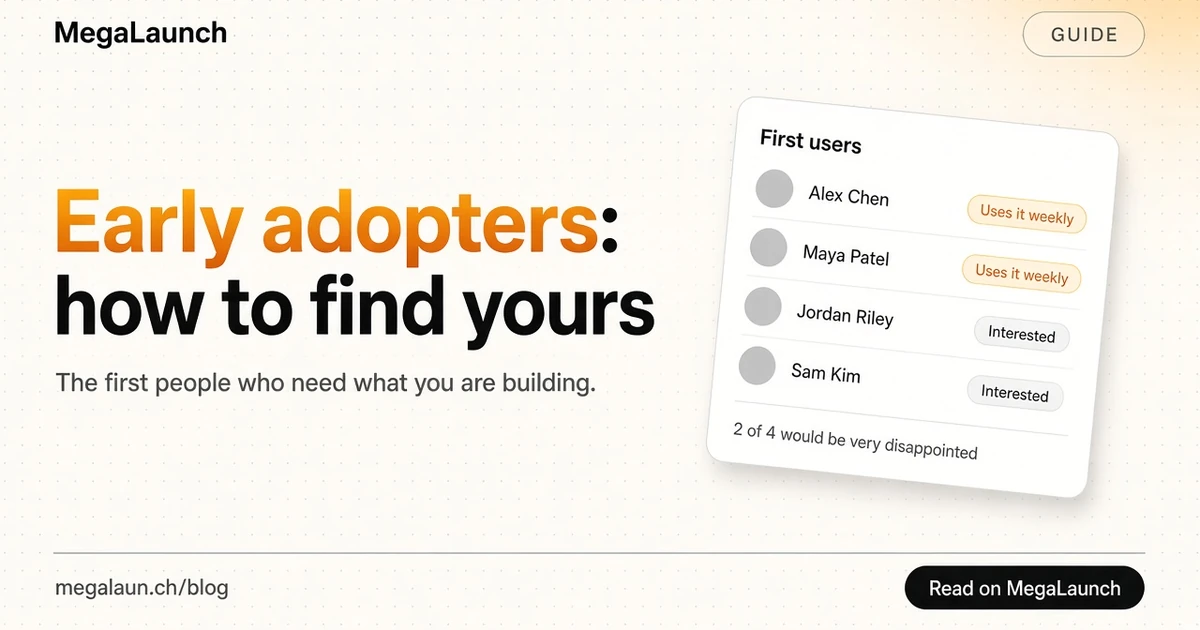
Every product that spreads starts with a few people who use it before it is good. They tolerate bugs, missing features and an ugly settings page because the product already solves something that hurts. These people are your early adopters, and finding the right ones matters more than finding many.
This guide explains where the term comes from, what makes someone a real early adopter for a startup, and a practical way to find and keep your first ones. Sources were checked on October 26, 2026.
In this article9
Where the term comes from
The idea comes from Everett Rogers' theory of the diffusion of innovations, first published in 1962. Rogers described five groups that adopt a new idea one after the other: innovators, early adopters, early majority, late majority and laggards. In his model, early adopters have the highest degree of opinion leadership of all the groups: others watch what they use.
Geoffrey Moore's book Crossing the Chasm added an important warning for technology products: there is a gap between early adopters and the early majority. Early adopters buy a vision and accept rough edges. The early majority wants a complete, proven solution and references from people like them. Many products win the first group and stall before the second.
For a new product, this has a practical consequence. Your first users will not behave like the mainstream market, so do not judge the product only by their enthusiasm. Judge it by whether they keep using it.
What a real early adopter looks like
"Early adopter" is often used to mean "someone who likes new gadgets". That definition is not very useful when you need your first customers. Steve Blank offers a sharper one. He calls the ideal first customers earlyvangelists and lists their traits:
- They have a problem.
- They know they have the problem.
- They are actively looking for a solution, with a timeline.
- The problem is painful enough that they built an interim solution.
- They have, or can quickly get, the budget to pay.
The fourth trait is the most useful filter. People who built a spreadsheet, a script or a manual routine to cope with the problem have proven that it matters to them. People who only say "nice idea" have not.
Early adopters are not the same as beta testers
The two groups overlap, but they do different jobs. Beta testers help you find bugs and confusing screens before launch. Some of them test because they are curious or because you asked a favor, and they stop when the beta ends. Early adopters use the product because they need it, and they keep using it when nobody is watching. A beta tester tells you what is broken. An early adopter tells you what is missing for their real work, and often pays to get it. Recruit both, but do not confuse one with the other.
Where to find early adopters
Early adopters gather where the problem is discussed, not where products are announced. Look for:
- Workarounds in public. Forum threads where people share their spreadsheet, their Zapier chain or their script. Every person in that thread is a candidate.
- Complaints about existing tools. Reviews, support forums and social posts where people describe what a competitor does badly.
- Communities of practice. Subreddits, Slack and Discord groups, newsletters and meetups for the job your product does.
- Your own history. Former colleagues and clients who had the problem with you.
- Early-stage platforms. Some launch platforms exist precisely for products in beta. Our comparison of BetaList alternatives lists the ones that accept unfinished products, and Product Hunt describes its own community as including early adopters (see our guide to launching on Product Hunt).
How to recruit them
Early adopters are recruited one at a time. Paul Graham's essay Do Things that Don't Scale describes how Stripe's founders, instead of saying "we'll send you a link", would set the product up for people on the spot. That level of effort is what turns a curious person into a user.
A simple approach that works:
- Start a conversation about the problem, not the product. Ask about the last time it happened and what they did. Rob Fitzpatrick's The Mom Test explains how to ask questions that people cannot answer with polite lies.
- Show the product only if the pain is real. If they describe a workaround, show them how your product replaces it.
- Set it up with them. Import their data, create their first project, stay on the call until they reach the first useful result.
- Ask for a commitment. A payment, a weekly check-in, or permission to watch them use it next week. A commitment separates interest from politeness.
If you are still before launch and need people to test, the guide to finding beta testers covers recruiting in larger numbers, and the pre-launch marketing plan shows how to fit these conversations into the weeks before launch day.
How to keep them
Early adopters forgive bugs, but not silence. To keep them:
- Reply fast and personally. A founder answering within hours is something big companies cannot offer.
- Ship what they ask for, visibly. When a request becomes a feature, tell the person who asked.
- Give them a way to be heard. A shared channel, a short monthly call, or simply your direct email.
- Thank them in public, if they agree: a mention in a changelog or a launch post.
How to know they are the right ones
Enthusiasm is not evidence. Measure behavior instead. One well-known method comes from Superhuman, described by First Round Review: ask users how they would feel if they could no longer use the product. Sean Ellis, who created the survey, found after benchmarking nearly a hundred startups that companies with strong traction almost always had more than 40% of users answer "very disappointed".
With a handful of early adopters, the percentage will be noisy, but the answers are still revealing. The people who would be very disappointed are your real early adopters. Study what they have in common and look for more people like them.
From early adopters to launch day
Your early adopters are also your best launch-day supporters: they can describe the product in their own words, and their comments are more convincing than yours. When you are ready to go public, the product launch strategy guide helps you choose between a soft launch, a beta and a big launch, and the launch checklist prepares the day itself.
Frequently asked questions
What is an early adopter?
In Everett Rogers' diffusion of innovations model, early adopters are the second group to adopt a new product, after innovators and before the early majority. For a startup, the practical definition is a person with an urgent problem who is willing to use an unfinished product because it solves that problem now.
What is the difference between early adopters and beta testers?
Beta testers help you find bugs and confusion before launch, sometimes without a strong need for the product. Early adopters need the product, keep using it and often pay for it early. The best beta testers become early adopters, but not all of them do.
How many early adopters do I need?
Fewer than you think. A small group of people who use the product every week and tell you honestly what is missing is enough to shape the first version. Depth of use matters more than the number.
Should early adopters get the product for free?
Not necessarily. Steve Blank argues that in markets where the user is also the payer, true early adopters are willing to pay for early access. An early discount is fine, but asking for money is one of the best ways to check that the need is real.
Sources
 @matthias_mrc
Put it into practice. Launch your product.
A permanent page, a followed link to your site, and makers who vote for what they like.
- Free with a link back to MegaLaunch
- Premium: $4.99 excl. VAT, one-time, no backlink needed
Done for you
We submit your product to 100+ dofollow directories.
By hand, with a report for every directory. No badge needed on your site.


From$99excl. VAT, one-time
See the plans