Directory submission sites: where to list your SaaS in 2026
Which directory submission sites are worth it for a SaaS or app: launch platforms, beta directories, alternatives sites and niche directories, plus a reusable submission kit and a tracking sheet.

Directory submission sites are websites that list products, startups or tools so people can discover them. For a new SaaS or app, a few good listings bring early visitors, first backlinks and social proof. Many directories, though, have no real audience and only send spam. This guide explains which types of directories are worth your time, how to prepare one submission kit you can reuse and how to measure what each listing brings.
In this article8
Why submit to directories
- Discovery. People browse launch platforms and software directories to find new tools, especially makers and early adopters.
- Backlinks. A listing usually links to your site. On a new domain, a handful of relevant links helps search engines find and trust your pages.
- Proof. Badges, upvotes and reviews on known sites reassure visitors who have never heard of you.
- Feedback. Comments on launch platforms often point out unclear messaging or missing features.
Listings also keep working after launch week: a good profile on an alternatives site can send a few visitors every month for years, long after the launch-day spike is gone.
Directories will not replace a real acquisition channel, but they are a cheap first step in your pre-launch marketing and launch week.
Types of directory submission sites
Launch platforms
Launch platforms feature new products on a given day or week, so the traffic arrives in a burst. MegaLaunch is built for indie makers and small SaaS teams. Product Hunt is the best known; it rewards preparation, and our Product Hunt launch guide covers it in detail. Show HN on Hacker News is for things people can try right away, and it has its own rules worth reading first.
Pre-launch and beta directories
BetaList focuses on startups that are not public yet. It is useful when you have a landing page and a waitlist and want early signups or beta testers.
Software alternatives sites
Sites like AlternativeTo and SaaSHub list software as alternatives to better-known products. They bring slower but steadier traffic from people searching "alternative to X". Pick the products you really replace and describe the difference honestly.
Niche directories
Directories for one category (AI tools, developer tools, design resources, no-code, a specific country) often convert better than general ones, because the visitors already want that kind of product. Search "[your category] directory" and "[your category] tools list" to find them.
Curated lists and newsletters
Community-maintained lists, "awesome" lists on GitHub and niche newsletters are not directories in the strict sense, but you submit to them the same way and they are often more trusted.
How to choose which directories to submit to
Before you submit, check each site quickly:
- Is it relevant? Do the listed products look like yours, and would your target users browse it?
- Does it have real visitors? Recent listings with comments, upvotes or reviews are a good sign. A page full of empty profiles is not.
- Is there editorial review? Directories that accept everything automatically tend to attract spam, and their links are worth less.
- What kind of link do you get? Many sites mark outbound links with nofollow or similar attributes. A nofollow listing can still bring visitors; just do not expect it to pass much SEO value.
- What does it cost? Many directories have a free option and a paid option for faster review or featured placement. Pay only after the free listing shows that the audience is real.
Avoid services that promise hundreds of directory submissions for a small fee. Mass, low-quality links rarely help and can hurt how search engines see your site. Our guide to free backlinks covers safer ways to earn links.
Prepare one submission kit
Most directories ask for the same things. Write them once in a document and reuse them:
- Product name and website URL.
- Tagline under 60 characters. See our tagline examples for inspiration.
- Short description of about 160 characters: who it is for, what it does, why it is different.
- Long description of 100 to 300 words, with your main use cases.
- Categories and tags you want to appear in.
- Logo as a square PNG or SVG, plus a version on a transparent background.
- Screenshots of the main screens, and a short demo video or GIF if you have one.
- Pricing (free, freemium, paid) and a launch offer if you run one.
- Founder name, social links and a contact email.
Vary the long description slightly between sites instead of pasting the exact same text everywhere, and lead with the benefit for the user.
Plan and track your submissions
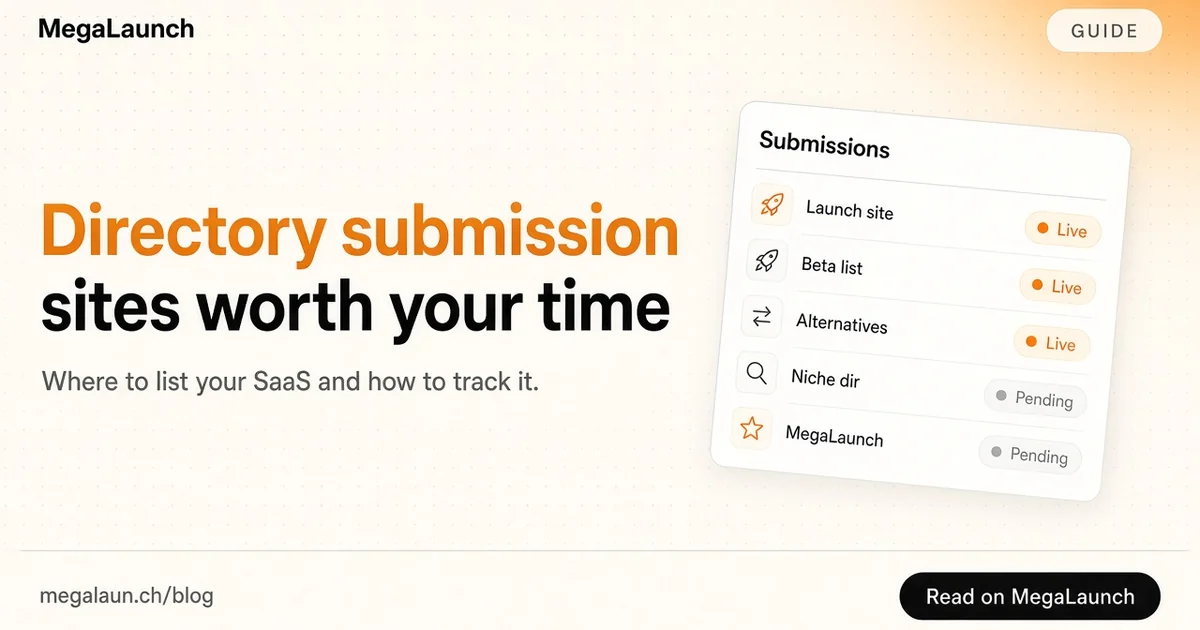
Use a simple spreadsheet with one row per directory: name, URL, type, cost, link type, date submitted, status (pending, live, rejected), listing URL and visits.
Add UTM parameters to the URL you submit, for example ?utm_source=betalist&utm_medium=directory, so your analytics shows which site sent each visitor and signup. Without this, directory traffic often shows up as generic referral traffic that you cannot attribute.
Spread submissions over two to four weeks rather than one afternoon. Launch platforms work best when they are timed with your public launch, while alternatives sites and niche directories can be done any time.
After the listing goes live
- Reply to every comment and review, fast. Directories often rank active listings higher.
- Add the badge some platforms offer to your site if it fits your design; it is a small trust signal.
- Update your listing when you ship big features or change pricing.
- After a month, compare visits and signups per directory and drop the ones that sent nothing.
Start with the highest-signal sites
You do not need fifty listings. Start with a launch platform like MegaLaunch for your launch day, one pre-launch directory, two alternatives sites and two or three niche directories in your category. Measure, then expand to more sites only where the first results justify it.
Frequently asked questions
Are directory submission sites still useful?
Relevant directories with real visitors still bring discovery, backlinks and social proof for new products. Mass submissions to low-quality directories rarely help and can hurt.
Which directories should a new SaaS submit to first?
Start with a launch platform for launch day, a pre-launch directory if you have a waitlist, two software alternatives sites and two or three niche directories in your category.
Do nofollow directory links help?
They pass little SEO value, but they can still send visitors and signups. Judge each listing by the traffic it brings, not only by the link type.
How do I track traffic from directories?
Add UTM parameters such as utm_source and utm_medium to the URL you submit, then compare visits and signups per directory in your analytics after a few weeks.
Sources
 @matthias_mrc
Put it into practice. Launch your product.
A permanent page, a followed link to your site, and makers who vote for what they like.
- Free with a link back to MegaLaunch
- Premium: $14.99 one-time, no backlink needed
Done for you
We submit your product to 100+ dofollow directories.
From one brief, with a report for every directory. No badge needed on your site.


From$99one-time
See the plans