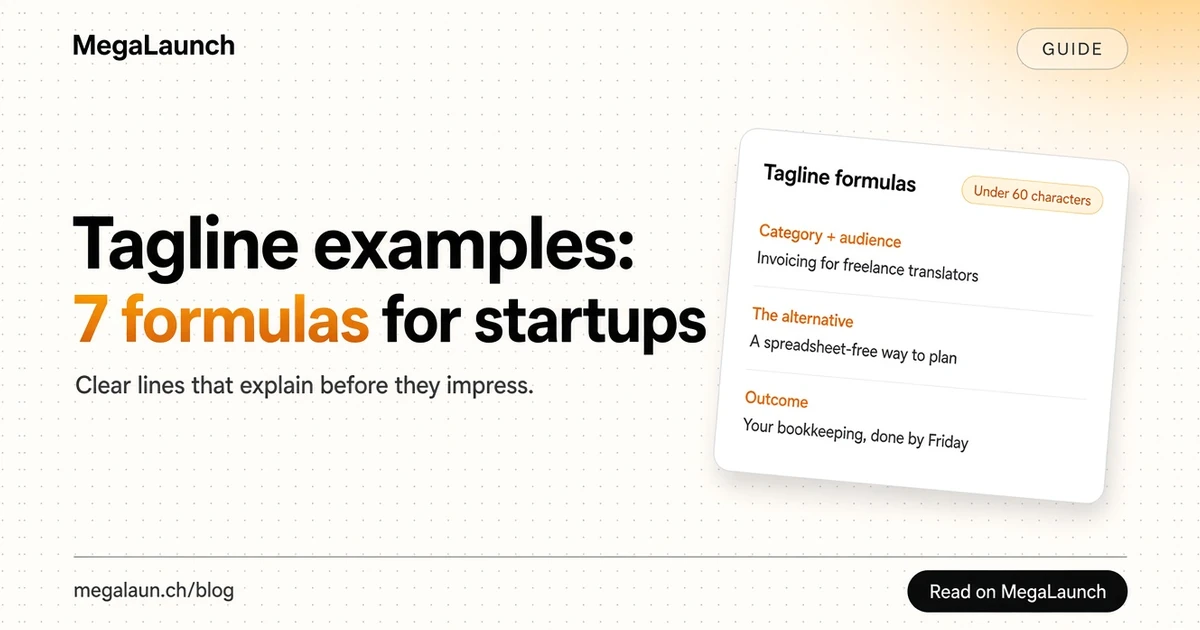
Tagline examples: 7 formulas for startups
Tagline examples for startups and SaaS, sorted into seven formulas you can copy, with real homepage lines, a tagline vs slogan explainer and a test checklist.

Most tagline examples you find online come from famous brands: Nike, Apple, a car rental company from the 1960s. They are memorable, but they were written for companies everyone already knew. A startup has the opposite problem. Nobody knows what you do, so your tagline has to explain before it can impress.
This guide sorts startup tagline examples into seven formulas you can copy, explains the difference between a tagline and a slogan, and ends with a short test. The homepage lines quoted below were checked on October 27, 2026; companies change them often.
In this article7
Tagline vs slogan
The two words are used loosely. According to Wikipedia's article on the tagline, a sentence presented next to a logo as an integral part of it is likely a tagline, and taglines are a form of advertising slogan. A practical way to separate them:
- A tagline stays with the product and explains it. It sits under the name on your homepage, your launch listing and your social bio.
- A slogan is often built for a campaign and made to be remembered.
Apple's "Think different" is a slogan: Wikipedia describes it as an advertising slogan used from 1997 to 2002, widely read as a response to IBM's "Think". It worked because everyone already knew what Apple sold. For a new product, start with a tagline that explains.
Why clarity wins for a new product
Your tagline is read in places where people scan: search results, launch platform feeds, link previews. Nielsen Norman Group's study on the first 2 words found that users typically see about two words of most list items when scanning. If your first two words are "The future" or "Reimagine your", the reader has learned nothing.
Launch platforms push in the same direction. Product Hunt's guide to preparing for launch limits the tagline to 60 characters and asks for a very short description with no gimmicks or over-the-top language, because the tagline is typically what makes someone click from the homepage.
Seven tagline formulas, with examples
Each formula below has a real homepage line where one exists, and invented examples you can adapt.
1. Category plus audience
Say what it is and who it is for.
- Linear: "The product development system for teams and agents"
- Invented: "Invoicing for freelance translators"
- Invented: "The CRM for two-person agencies"
Best when your category is known and your audience is the differentiator.
2. The alternative you replace
Name the tool people already use, then your difference.
- Plausible: "Easy to use and privacy-friendly Google Analytics alternative"
- Invented: "A spreadsheet-free way to plan a podcast season"
Best when buyers already compare you to a known product. It also helps search, because people type the alternative's name.
3. The simplest way to
Claim one quality on one job.
- Tally: "The simplest way to create forms"
- Invented: "The fastest way to send a weekly client report"
Best when your edge is ease or speed. Only use it if a new user would agree within five minutes.
4. Outcome, handled
Describe the result, not the tool.
- Calendly: "All the work around meetings, handled."
- Invented: "Your bookkeeping, done before Friday"
Best when the job is tedious and the user mostly wants it gone.
5. Verb, object, context
Start with what the user does.
- Basecamp (homepage title): "Manage projects, coordinate teams, and master your company"
- Invented: "Turn customer calls into searchable notes"
Best for tools with a clear main action. Starting with a verb puts meaning in the first two words.
6. Wordplay on the benefit
A twist that still explains.
- Dropbox: "Get to work, with a lot less work"
- Invented: "Ship docs, not drafts"
Use with care. Read it to someone outside your field: if they cannot say what the product does, it is a slogan, not a tagline.
7. Proof or specific number
A concrete detail makes a claim believable.
- Invented: "Uptime alerts in under a minute, by SMS"
- Invented: "Translate your app into 30 languages from one file"
Only use numbers you can prove on the page. This formula is the closest to what advertising calls a unique selling proposition: a specific benefit the competition does not offer.
How to write yours
- Decide your positioning first. A tagline compresses positioning; it cannot replace it. April Dunford's book Obviously Awesome is a good guide to choosing your competitive alternatives, the value you add and the customers who care most.
- Pick two formulas from the list above that fit your situation.
- Write ten versions of each. The first ones are always generic. The free tagline generator gives you a starting batch from three answers.
- Cut the filler. Remove "powerful", "seamless", "all-in-one" and "next generation" unless the line breaks without them.
- Check the length. Paste the finalists into the headline and tagline analyzer and keep the ones under 60 characters.
Mistakes that make a tagline forgettable
- Describing the company instead of the product. "Building the future of work" could belong to a thousand startups. Say what the product does today.
- Stacking features. "Chat, docs, tasks and AI in one place" reads like a menu. Pick the one job that brings people in.
- Writing for investors. Words like "platform", "ecosystem" and "infrastructure" impress in a deck and confuse a first visitor.
- Using inside jargon. If your customers do not use a word, it does not belong in the line. Borrow the exact words you hear in support tickets and interviews.
- Changing it every week. A tagline gets stronger as people see it in several places. Test before launch, then keep it long enough to measure whether it works.
Test it before launch
Show your top three lines, without the product name, to five people who match your customer. Ask one question: "What do you think this product does?" Keep the line they describe correctly most often, even if it is not your favorite.
Then reuse it everywhere: homepage headline, social bios, your launch announcement, and every launch listing. If you are preparing a Product Hunt launch, the 60 character version is the one to keep. When the line is ready, you can also list your product on MegaLaunch, where the tagline is shown next to your product name.
Frequently asked questions
What is a tagline?
A tagline is a short line that sits next to a product or company name and sums up what it is or why it matters. For a startup, it usually answers what the product does and for whom, in one line that can be reused on the website, launch platforms and social profiles.
What is the difference between a tagline and a slogan?
The words overlap. A tagline usually stays attached to the brand or product for a long time and explains it, while a slogan is often made to be remembered for a campaign. Wikipedia describes taglines as a form of advertising slogan, so in practice the difference is about use, not format.
How long should a tagline be?
Short enough to read in one glance. Product Hunt limits taglines to 60 characters, which is a good default for most platforms. Under about eight words is a useful target for a homepage.
Should a startup tagline be clever or clear?
Clear first. People who do not know your product need to understand it immediately. Clever lines can work once the category and the brand are already known.
Sources
Free tools mentioned in this article
- Tagline GeneratorTagline ideas from your product, audience and benefit, with live counters for X, Product Hunt and the App Store.
- Headline and Tagline AnalyzerPaste a headline, tagline or description and see characters, words and vague wording against your own targets.
 @matthias_mrc
Put it into practice. Launch your product.
A permanent page, a followed link to your site, and makers who vote for what they like.
- Free with a link back to MegaLaunch
- Premium: $4.99 excl. VAT, one-time, no backlink needed
Done for you
We submit your product to 100+ dofollow directories.
By hand, with a report for every directory. No badge needed on your site.


From$99excl. VAT, one-time
See the plans