LTV calculator: how to work out customer lifetime value
How to calculate customer lifetime value (LTV) for SaaS with gross margin and churn, a simple spreadsheet LTV calculator, the LTV to CAC ratio and ways to increase LTV.

Customer lifetime value (LTV) tells you how much revenue, or better, how much gross profit, a customer brings in before they leave. It is the number that decides how much you can afford to spend to win a customer, which pricing makes sense and whether a channel is worth scaling. This guide gives you the LTV formulas, a simple calculator you can rebuild in a spreadsheet in five minutes, a worked example and the mistakes that make LTV look better than it is.
In this article9
What LTV measures
Customer lifetime value is the total value a customer generates over the whole relationship with your business. For a subscription product, that relationship ends when the customer cancels, so LTV depends on two things: how much a customer pays each month and how long they stay.
For early-stage SaaS and indie products, you rarely have enough history to observe a full customer lifetime. That is why LTV is usually estimated from current numbers: average revenue per account, gross margin and churn.
The LTV formulas
There are three versions, from simplest to most useful.
1. Revenue LTV
LTV = ARPA x average customer lifetime
ARPA is average revenue per account per month, the B2B cousin of average revenue per user. Average customer lifetime in months is 1 divided by your monthly churn rate.
2. Revenue LTV from churn
LTV = ARPA / monthly churn rate
This is the same formula written differently. If 5% of customers cancel each month, the average customer stays 1 / 0.05 = 20 months.
3. Gross margin LTV (use this one)
LTV = (ARPA x gross margin) / monthly churn rate
Revenue is not profit. Hosting, payment fees, support and third-party APIs cost money for every customer. Multiplying by gross margin gives you the profit a customer contributes, which is what you should compare with acquisition cost.
A simple LTV calculator
You can build this in any spreadsheet with five cells:
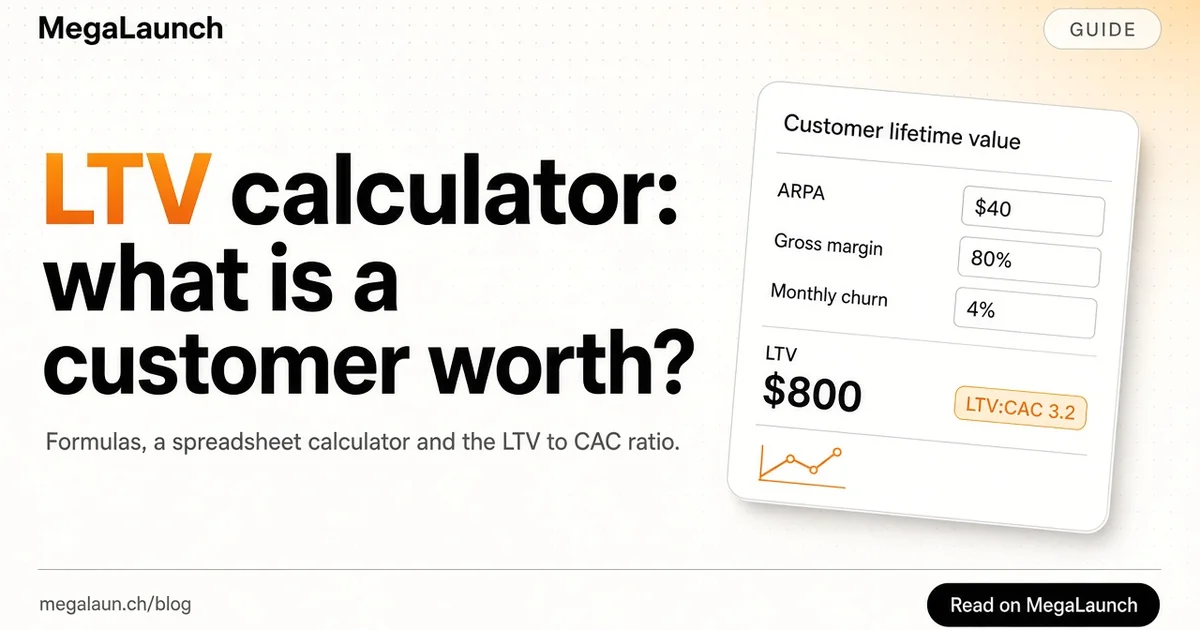
| Cell | Input | Example value |
|---|---|---|
| A | Monthly revenue (MRR) | $4,000 |
| B | Paying customers | 100 |
| C | ARPA = A / B | $40 |
| D | Gross margin | 80% |
| E | Monthly churn rate | 4% |
| LTV | C x D / E | $800 |
These are example numbers. With $40 a month per customer, 80% gross margin and 4% monthly churn, the average customer stays 25 months and contributes $800 of gross profit.
How to get churn right
Churn rate is the share of customers who cancel in a period. Monthly customer churn = customers lost during the month / customers at the start of the month.
Three practical rules:
- Use paying customers only. Free users who never pay do not churn in a way that affects LTV.
- Average several months. With 50 customers, one cancellation moves churn by 2 points. Use a three to six month average.
- Do not use 0%. A young product with no cancellations yet would get an infinite LTV. Use a conservative assumption such as 5% to 8% monthly until you have data.
LTV to CAC ratio
LTV only becomes useful when you compare it with customer acquisition cost. If you have not calculated CAC yet, our CAC calculator guide walks through it.
LTV to CAC = LTV / CAC
With the example above and a CAC of $250, the ratio is 800 / 250 = 3.2.
Common rules of thumb for SaaS:
- Below 1: every customer loses money. Fix pricing, churn or acquisition before spending more.
- Around 3: a healthy balance between growth and efficiency.
- Above 5: you may be under-investing in growth, or CAC is understated.
Also check CAC payback: CAC / (ARPA x gross margin). Here 250 / 32 is about 8 months. A short payback matters more than a high ratio when cash is tight, because LTV is earned over years while acquisition is paid today.
Segment your LTV
A blended LTV hides the most useful information. Calculate it separately for:
- Plans. Annual plans often churn less than monthly ones, and higher tiers usually pay more.
- Acquisition channels. Customers from a launch platform, SEO, ads or referrals can behave very differently.
- Signup months. Cohort analysis groups customers by when they joined and tracks how many are still paying after 1, 3, 6 and 12 months. It shows whether retention is improving as the product matures.
A simple cohort table has signup month in rows, months since signup in columns and the percentage still paying in each cell. Once you have six months of data, use the observed retention curve instead of the churn formula.
Common LTV mistakes
- Using revenue instead of gross profit. This inflates LTV by 20% to 40% for a typical SaaS.
- Assuming churn stays constant. Many products lose a lot of customers in the first month or two, then retain the rest well. Early churn and late churn tell different stories.
- Counting expansion you hope for. Only include upgrades and seat expansion you already observe.
- Ignoring refunds and failed payments. Involuntary churn from expired cards can be a large share of total churn.
- Projecting 10-year lifetimes. Cap lifetime at 3 to 5 years for planning, even if the formula says more.
How to increase LTV
There are only three levers: charge more, keep customers longer or improve margin.
- Reduce early churn with onboarding. Make sure new customers reach the first useful result quickly. Most cancellations happen before that moment.
- Offer annual plans. A discount of about two months for paying yearly locks in revenue and reduces churn.
- Recover failed payments. Turn on card retry and reminder emails in your billing tool.
- Add an upgrade path. Usage-based limits, team seats or a higher tier let customers grow with you. See our guide to SaaS pricing models.
- Talk to customers who cancel. A short exit survey shows whether churn comes from price, missing features or the wrong customer profile.
- Watch gross margin. API and infrastructure costs can grow faster than revenue on AI products; set usage limits per plan.
What to do with your number
Once you know LTV, use it to set a ceiling for acquisition spend. If LTV is $800 and you target a ratio of 3, you can spend up to about $265 to acquire a customer. That tells you whether paid ads are realistic or whether you should focus on cheaper channels such as content, communities and launch platforms.
Recalculate LTV every month, alongside MRR, churn and CAC. The trend matters more than the exact figure: if LTV rises while CAC stays flat, your business is getting healthier.
Frequently asked questions
How do you calculate customer lifetime value?
For a subscription product, multiply average monthly revenue per account by your gross margin, then divide by your monthly churn rate. With $40 a month, 80% margin and 4% churn, LTV is $800.
What is a good LTV to CAC ratio?
About 3 to 1 is a common SaaS rule of thumb. Below 1 to 1 each customer loses money; well above 5 to 1 may mean you could invest more in growth.
Should LTV use revenue or gross margin?
Gross margin. Hosting, payment fees, support and API costs are paid for every customer, so LTV based on gross profit is the figure to compare with acquisition cost.
How do you estimate LTV with no churn data yet?
Do not use 0% churn, which gives an infinite LTV. Assume a conservative monthly churn such as 5% to 8% and replace it with real cohort data once you have a few months of history.
Sources
 @matthias_mrc
Put it into practice. Launch your product.
A permanent page, a followed link to your site, and makers who vote for what they like.
- Free with a link back to MegaLaunch
- Premium: $14.99 one-time, no backlink needed
Done for you
We submit your product to 100+ dofollow directories.
From one brief, with a report for every directory. No badge needed on your site.


From$99one-time
See the plans