CAC calculator: how to work out customer acquisition cost
How to calculate customer acquisition cost (blended and per channel), a simple spreadsheet CAC calculator, LTV to CAC ratio, CAC payback and ways to lower CAC.

Customer acquisition cost (CAC) tells you how much you spend to win one new paying customer. For a SaaS founder or indie maker, it is the number that decides whether a marketing channel is worth keeping, whether your pricing works and whether growth will make you richer or poorer. This guide shows you how to calculate CAC with a simple calculator you can rebuild in a spreadsheet, how to read it next to lifetime value and payback, and how to lower it.
In this article10
What customer acquisition cost is
Customer acquisition cost is the total cost of sales and marketing over a period divided by the number of new customers won in that same period. It includes everything you spend to turn strangers into paying users: ads, sponsorships, content, tools, freelancers, and the salaries of people working on sales and marketing.
The basic formula:
CAC = total sales and marketing costs / number of new paying customers
If you spent $3,000 on marketing last quarter and gained 60 new paying customers, your CAC is $50.
Blended CAC vs paid CAC
Founders often mix up two different numbers:
- Blended CAC divides all sales and marketing costs by all new customers, including those who found you through word of mouth, search or a launch.
- Paid CAC divides the spend on one paid channel by the customers that channel brought in.
Blended CAC tells you whether the business as a whole acquires customers efficiently. Paid CAC tells you whether a specific channel deserves more budget. A low blended CAC can hide a paid channel that loses money, so calculate both.
A simple CAC calculator
You can build a reliable calculator in a spreadsheet with these inputs for a given month or quarter:
| Input | Example (one quarter) |
|---|---|
| Ad spend | $1,800 |
| Marketing tools and software | $300 |
| Freelancers and content | $900 |
| Share of founder or team salary spent on marketing | $1,500 |
| Sponsorships and paid launches | $500 |
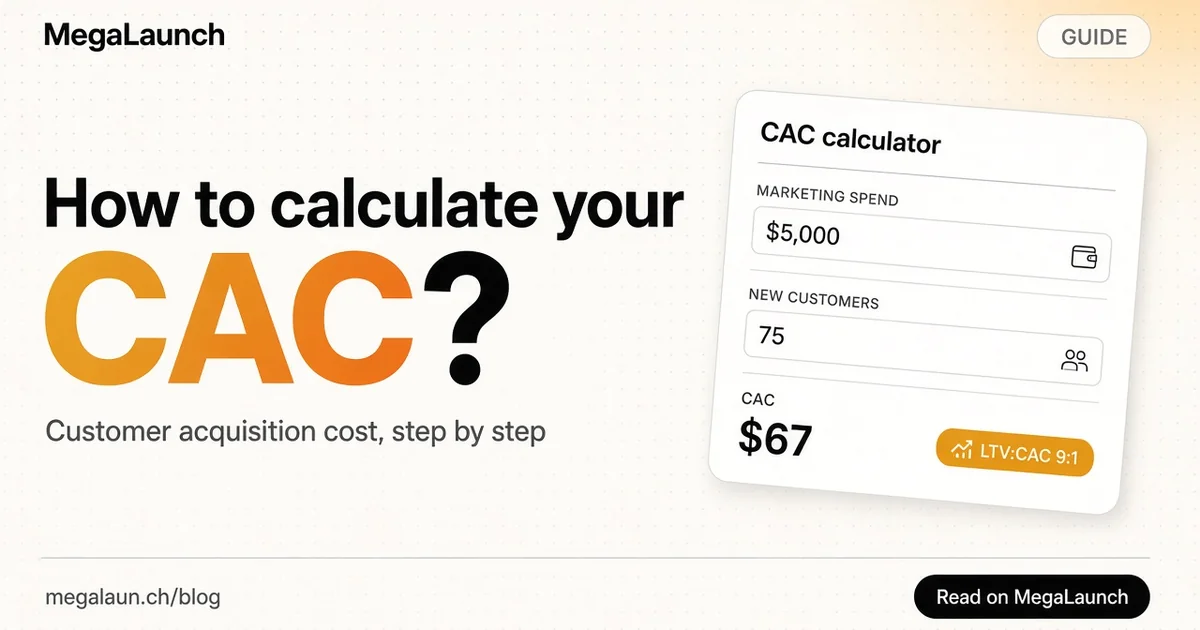
| New paying customers | 75 |
Total cost: $5,000. CAC = $5,000 / 75 = about $67.
Two rules keep the number honest:
- Count only paying customers. Free signups and trials that never convert do not belong in the denominator.
- Include your own time if it is a real cost. Bootstrapped founders often leave out their own hours, which makes CAC look artificially low. At least estimate it, even if you report CAC with and without it.
These numbers are illustrations only; replace them with your own data.
Track where customers come from
Per-channel CAC is only possible if you know which channel brought each customer. The simplest setup:
- tag every link you share with UTM parameters (source, medium, campaign); our free UTM builder generates them in seconds
- store the first source on the user record at signup
- ask "How did you hear about us?" in onboarding to catch word of mouth, podcasts and communities that links miss
Even rough attribution beats none. A spreadsheet with one row per channel, its monthly spend and the paying customers it produced is enough to start.
CAC and lifetime value
CAC means little on its own. A $200 CAC is excellent if a customer pays $2,000 over their lifetime and terrible if they pay $100. That is why CAC is always read next to customer lifetime value (LTV).
For a subscription product, a simple LTV estimate is:
LTV = average monthly revenue per customer x gross margin / monthly churn rate
Example: $30 a month, 80 percent gross margin and 4 percent monthly churn gives $30 x 0.8 / 0.04 = $600.
A widely used rule of thumb in SaaS is an LTV to CAC ratio of about 3 to 1. Below 1 to 1, every new customer loses money. Far above 5 to 1 can mean you are underinvesting in growth. With an LTV of $600 and a CAC of $67, the ratio is about 9 to 1, a sign you could spend more on the channels that work.
CAC payback period
LTV relies on churn estimates that are shaky for young products. The payback period is more concrete: how many months of gross profit it takes to earn back the cost of acquiring a customer.
CAC payback (months) = CAC / (monthly revenue per customer x gross margin)
With a $67 CAC and $30 a month at 80 percent margin: $67 / $24 = about 2.8 months.
For a bootstrapped company, payback matters more than the ratio, because it decides how fast cash spent on marketing comes back to fund the next month. Under 12 months is often treated as healthy for SaaS; a few months is excellent. If payback is long, your burn rate rises every time you grow, so check it against your runway.
How to lower your CAC
- Fix conversion before buying traffic. A clearer landing page, a shorter signup and a better onboarding lower CAC on every channel at once.
- Invest in channels that compound. SEO, useful content, free tools and an email list cost time upfront but keep bringing customers without new spend.
- Launch on directories and launch platforms. A launch brings early adopters for the price of a listing, and backlinks that help search later.
- Use direct outreach early. A few well-written cold emails to the right people often beat ads when you have under 100 customers.
- Raise prices or move upmarket. CAC often stays similar while revenue per customer rises. See our guide to SaaS pricing models.
- Reduce churn. Keeping customers longer raises LTV, which makes the same CAC more affordable.
- Cut channels that never pay back. If a channel's payback is longer than your runway, pause it.
For a fuller plan across channels, our SaaS marketing strategy guide shows how to combine them.
Common CAC mistakes
- Mixing periods. Spend in one quarter often brings customers in the next. For long sales cycles, compare spend with customers won one period later.
- Counting trials as customers. It flatters the number and hides poor conversion.
- Ignoring organic channels. Blended CAC falls when word of mouth grows; do not credit that to ads.
- Measuring once. CAC changes with season, saturation and pricing. Recalculate monthly.
The bottom line
CAC is total sales and marketing cost divided by new paying customers. Calculate blended and per-channel CAC, read it next to LTV and payback, and track sources from the first signup. Lower it by improving conversion and investing in channels that compound, such as a launch that keeps sending visitors: list your product on MegaLaunch to reach makers and early adopters.
Frequently asked questions
How do you calculate customer acquisition cost?
Add up all sales and marketing costs for a period, including ads, tools, freelancers and the time spent on marketing, then divide by the number of new paying customers won in that period.
What is a good LTV to CAC ratio?
About 3 to 1 is a common SaaS benchmark. Below 1 to 1 each customer loses money; well above 5 to 1 can mean you could invest more in growth.
What is CAC payback period?
It is the number of months of gross profit needed to earn back the cost of acquiring a customer: CAC divided by monthly revenue per customer times gross margin. Under 12 months is often considered healthy for SaaS.
Should free users be counted in CAC?
No. Count only paying customers, otherwise CAC looks lower than it really is and hides weak conversion from free to paid.
Sources
Free tools mentioned in this article
All free tools @matthias_mrc
Put it into practice. Launch your product.
A permanent page, a followed link to your site, and makers who vote for what they like.
- Free with a link back to MegaLaunch
- Premium: $14.99 one-time, no backlink needed
Done for you
We submit your product to 100+ dofollow directories.
From one brief, with a report for every directory. No badge needed on your site.


From$99one-time
See the plans