Cold email template: 5 examples that get replies
Five short cold email templates for founders and indie makers (first users, customer interviews, partnerships, press, follow-up), plus deliverability and legal basics.

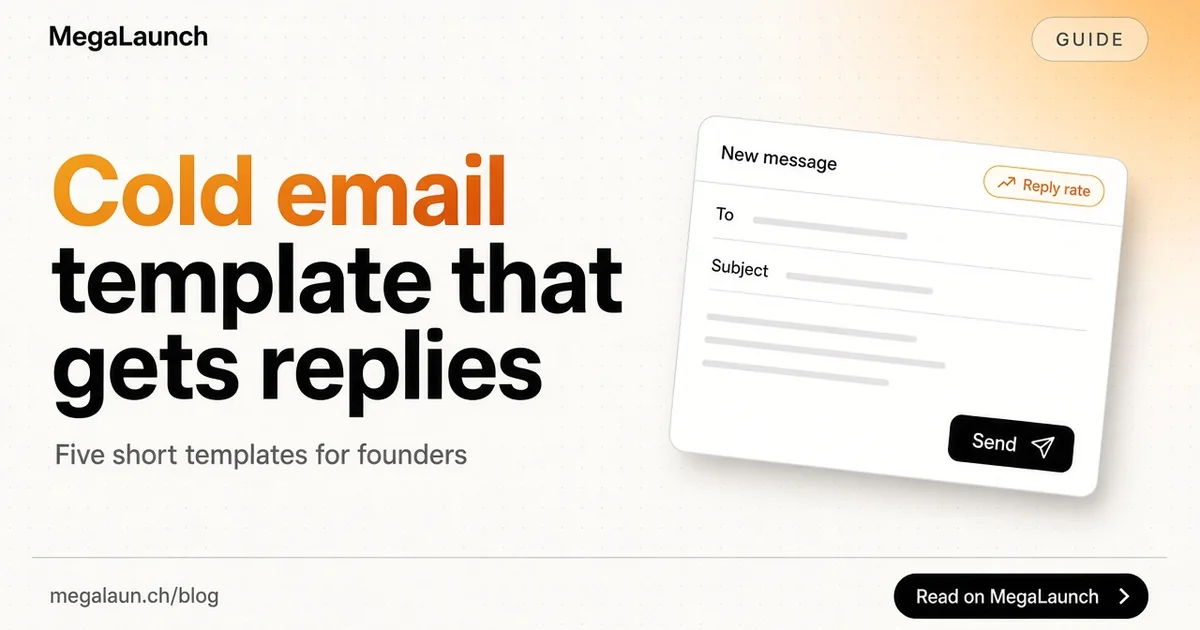
A cold email is a message to someone who has never heard of you and did not ask to hear from you. For an indie maker or early-stage founder, it is still one of the cheapest ways to reach your first users, partners, journalists and investors. Most cold emails fail for the same reasons: they are long, vague and about the sender. This guide gives you five short cold email templates you can copy, the rules that make them work, and the legal and deliverability basics you need before you hit send.
In this article8
What makes a cold email work
A cold email is judged in about three seconds. The reader looks at who sent it, the subject line and the first sentence, then decides to read, archive or report it. Good cold emails share five traits:
- One person, one reason. The first line shows why you wrote to this person and not to a list.
- One clear ask. A reply, a 15-minute call, a test of the product. Never three asks at once.
- Short. Aim for 50 to 125 words. If it scrolls on a phone, it is too long.
- About them. Count the sentences that start with "I" or "we". Cut half of them.
- Easy to say no to. People reply more when declining is painless.
The anatomy of a cold email template
Every template below follows the same structure. Once you see it, you can write your own:
- Subject line: 2 to 6 words, lowercase is fine, no clickbait. "question about your onboarding" beats "Quick opportunity!!".
- Personal opening: one sentence that proves you looked at their work.
- Context: who you are, in one line.
- Value or problem: what is in it for them.
- The ask: one small, specific next step.
- Signature: your name, product, one link.
Five cold email templates for founders
Replace everything in brackets. Do not send any of these unchanged; the personal line is what earns the reply.
1. Finding your first users
Subject: [their tool or workflow] question
Hi [Name],
I saw your post about [specific problem] in [community]. I am building [product], which [one-line outcome] for [type of person].
Would you try it for 10 minutes this week and tell me what is confusing? No sales call, just honest feedback.
[Your name] [product URL]
This one pairs well with our guides on finding beta testers and early adopters. Paul Graham's essay Do Things That Don't Scale explains why recruiting users one by one is normal at this stage.
2. Customer discovery, before you build
Subject: how do you handle [task]?
Hi [Name],
I am researching how [role] handle [task], and your [article, talk, repo] stood out. I am not selling anything yet.
Could I ask you three questions over a 15-minute call next week? Happy to share what I learn from the other interviews.
[Your name]
In the call itself, ask about past behaviour, not opinions about your idea. The Mom Test by Rob Fitzpatrick is the standard guide for this. If you are still testing the idea, read our idea validation guide first.
3. Partnership or link exchange
Subject: [their site] + [your site]
Hi [Name],
I read your guide on [topic] and linked to it from our article on [related topic] because it answers [question] better than anything else I found.
We serve a similar audience of [audience]. Would you be open to [specific idea: a guest post, a mutual mention, a shared resource page]?
[Your name], [product]
Lead with what you already gave. A link you placed before asking is more convincing than a promise.
4. Press or newsletter pitch
Subject: [product] for your [section or newsletter]
Hi [Name],
You covered [related story] last month. [Product] launches on [date] and [one fact that makes it news: a number, a first, a strong user quote].
I can send screenshots, a short demo video and early access. Would this fit [publication]?
[Your name]
Attach nothing on the first email; offer it instead. For longer coverage, prepare a product launch press release you can share when someone says yes.
5. The follow-up
Subject: re: [original subject]
Hi [Name], bumping this in case it got buried. If [ask] is not a fit right now, a one-word "no" is completely fine.
[Your name]
Send one or two follow-ups, three to five days apart, then stop. Many replies come from the follow-up, but a third or fourth reminder mostly earns spam reports.
Deliverability: make sure it lands in the inbox
The best template is useless in a spam folder. Before sending at any volume:
- Authenticate your domain. Set up SPF, DKIM and DMARC. Email authentication is how Gmail and Yahoo decide your mail is really from you.
- Follow the big inbox rules. Google's email sender guidelines require authentication, low spam rates and, for bulk senders, one-click unsubscribe. Yahoo publishes similar sender best practices.
- Use a real mailbox, not a no-reply address, and send from a domain you have warmed up with normal mail.
- Send in small batches. Ten to thirty well-researched emails a day beats five hundred generic ones.
- Keep links to one or two. Every extra link, image and tracking pixel makes a message look more like marketing.
The legal basics
Cold email is legal in many places, but the rules differ by country, so check where your recipients live. In the United States, the CAN-SPAM Act requires an honest subject line, a real sender identity, a physical postal address and a working way to opt out. In the UK and EU, rules on electronic marketing are stricter, especially for messages to individuals rather than companies; the UK regulator's direct marketing guidance is a clear starting point. When in doubt, write to business addresses about business topics, keep a short reason for contacting each person, and honour every opt-out immediately.
Common cold email mistakes
- Opening with your name and company. Open with them.
- Pasting a pitch deck or PDF. Attachments look like spam and rarely get opened.
- Asking for a 30-minute call with a stranger. Ask for a reply or 15 minutes.
- Fake familiarity. "Hope you are well!" and "Re:" on a first email both erode trust.
- No tracking of results. Keep a simple sheet: date, person, template, reply or not. After 50 emails you will know which template works for you.
Where cold email fits in a launch
Cold email works best alongside public channels. Use it to recruit testers before a soft launch, to reach journalists and newsletter writers in the week before launch day, and to thank and follow up with people after. Our product launch email guide covers the messages you send to people who already signed up. When your product is live, you can also list it on MegaLaunch so the people you emailed have a public page to check and share.
Frequently asked questions
How long should a cold email be?
Aim for 50 to 125 words. The reader should understand who you are, why you wrote to them and what you are asking without scrolling on a phone.
How many follow-ups should I send after a cold email?
One or two follow-ups, three to five days apart, are usually enough. After that, stop: extra reminders mostly lead to spam reports.
Is cold email legal?
In many countries it is, under conditions. In the US, CAN-SPAM requires an honest subject, a real sender, a postal address and an opt-out. UK and EU rules are stricter, especially for emails to individuals, so check the rules where your recipients live.
What is a good subject line for a cold email?
Short, specific and plain: two to six words that mention the person, their product or the topic, such as "question about your onboarding". Avoid hype, capitals and fake "Re:" prefixes.
Sources
 @matthias_mrc
Put it into practice. Launch your product.
A permanent page, a followed link to your site, and makers who vote for what they like.
- Free with a link back to MegaLaunch
- Premium: $14.99 one-time, no backlink needed
Done for you
We submit your product to 100+ dofollow directories.
From one brief, with a report for every directory. No badge needed on your site.


From$99one-time
See the plans