Churn rate calculator: how to calculate SaaS churn
How to calculate customer churn and revenue churn for a SaaS, build a churn rate calculator in a spreadsheet, convert monthly to annual churn, read cohorts and reduce churn.

Churn rate is the share of customers or revenue you lose over a period. For a subscription product it is the number that decides whether growth compounds or leaks away. This guide shows how to calculate customer churn and revenue churn, how to build a simple churn rate calculator in a spreadsheet, what counts as a good churn rate and how to reduce it.
In this article8
The churn rate formula
The basic churn rate formula for a month is:
Churn rate = customers lost during the month / customers at the start of the month
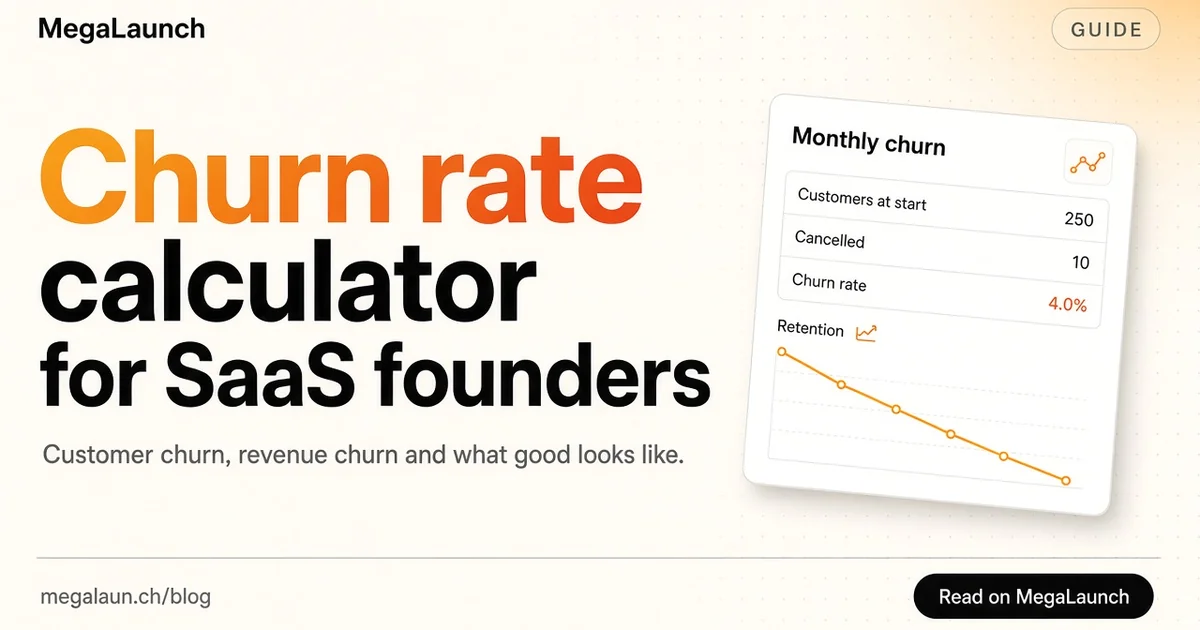
Example: you start the month with 250 paying customers and 10 cancel. Monthly churn is 10 / 250 = 4.0%.
Three rules keep the number honest:
- Count only customers at the start of the period. New customers who sign up and cancel in the same month are a separate problem (activation) and should be tracked apart, or they distort the rate.
- Count paying customers only. Free users and trials have their own conversion metrics.
- Use one definition of "lost". Usually the subscription ended or was not renewed. Decide whether a failed payment counts as churn on the day it fails or after your retry period, and keep that rule.
Customer churn vs revenue churn
Customer churn counts accounts. Revenue churn counts money, which matters when plans have different prices.
Gross revenue churn = (MRR lost to cancellations + MRR lost to downgrades) / MRR at the start of the month
Net revenue churn = (MRR lost to cancellations + downgrades - MRR gained from upgrades) / MRR at the start of the month
Example with $10,000 MRR at the start of the month: $350 cancelled, $100 downgraded, $300 of upgrades. Gross revenue churn is 4.5%. Net revenue churn is 1.5%. If upgrades exceed losses, net revenue churn is negative, which means existing customers grow revenue on their own. If you need MRR first, our ARR calculator guide shows how to normalize monthly and annual plans.
Build a churn rate calculator in a spreadsheet
Create one row per month with these columns:
| Column | Content |
|---|---|
| A | Month |
| B | Paying customers at start |
| C | New paying customers |
| D | Customers cancelled |
| E | Customers at end = B + C - D |
| F | Customer churn = D / B |
| G | MRR at start |
| H | MRR lost (cancellations + downgrades) |
| I | MRR expansion (upgrades) |
| J | Gross revenue churn = H / G |
| K | Net revenue churn = (H - I) / G |
Format F, J and K as percentages. Add a row under the table with the average of the last three to six months, because one month of churn on a small customer base is noisy. With 40 customers, one cancellation moves churn by 2.5 points.
Monthly vs annual churn
Monthly and annual churn do not convert by multiplying by 12. Retention compounds:
Annual churn = 1 - (1 - monthly churn)^12
At 4% monthly churn, you keep 0.96^12 = 61% of customers after a year, so annual churn is about 39%, not 48%. At 2% monthly churn, annual churn is about 22%.
Average customer lifetime
A rough estimate of how long a customer stays is 1 / monthly churn. At 4% churn that is 25 months. This feeds directly into lifetime value; see our LTV calculator guide for the full formula with gross margin.
What is a good churn rate?
There is no single benchmark, and published figures vary by source, but the pattern is consistent:
- Products for consumers and very small businesses often see monthly churn of several percent, because customers try many tools and budgets change fast.
- Products sold to larger companies on annual contracts tend to have much lower churn, because switching costs are higher and renewals happen once a year.
- Early products usually churn more than mature ones. That is normal while you are still finding which customers get the most value.
Compare yourself with your own past months first. A falling trend matters more than hitting an industry number.
Look at cohorts, not only the average
The average churn rate hides when customers leave. Cohort analysis groups customers by signup month and tracks how many are still paying after 1, 2, 3 and more months.
Typical patterns:
- Most churn in month one or two. The problem is onboarding or a mismatch between promise and product.
- Steady churn every month. The product is not becoming part of the routine; look at usage frequency.
- Curves that flatten. Good sign: the customers who stay find lasting value. Focus acquisition on people like them.
Survival analysis is the statistical version of the same idea if you want to go further, but a cohort table in a spreadsheet is enough for most indie products.
How to reduce churn
Start with the cause you can measure, then work on the others.
- Fix failed payments. Involuntary churn from expired or declined cards is often a large share of losses for small SaaS products. Turn on card retries, card updater features from your payment provider and reminder emails. This process is called dunning.
- Improve the first week. Define the action that shows a new customer got value, and guide every new account to it with in-app steps and short emails.
- Ask why people leave. Add one required question to the cancellation flow with a few options and a free text field. Read every answer.
- Offer alternatives to cancelling. A pause, a cheaper plan or an annual discount keeps some customers who would otherwise leave for budget reasons.
- Sell annual plans. Annual billing reduces the number of renewal decisions per year. Our guide to SaaS pricing models covers how to structure them.
- Talk to customers before they leave. A short survey such as Net Promoter Score can flag unhappy accounts early, as long as you follow up personally.
Reducing churn is mostly about customer retention work that happens long before the cancel button: clear onboarding, regular value and fast support.
Common churn calculation mistakes
- Dividing by customers at the end of the month instead of the start.
- Mixing free and paid users.
- Reporting one good month instead of a three-month average.
- Ignoring downgrades, which lose revenue without losing customers.
- Converting monthly churn to annual churn by multiplying by 12.
Track churn every month with the same definitions, and it becomes one of the most useful numbers you have: it tells you whether to work on acquisition or on keeping the customers you already have.
Frequently asked questions
How do you calculate churn rate?
Divide the paying customers lost during a period by the paying customers at the start of that period. With 250 customers at the start of the month and 10 cancellations, monthly churn is 4%.
How do you convert monthly churn to annual churn?
Use 1 - (1 - monthly churn)^12. At 4% monthly churn you keep about 61% of customers after a year, so annual churn is about 39%, not 48%.
What is the difference between gross and net revenue churn?
Gross revenue churn counts MRR lost to cancellations and downgrades. Net revenue churn subtracts MRR gained from upgrades, so it can be negative when existing customers grow.
What is a good churn rate for SaaS?
It depends on the market: products for consumers and very small businesses often churn several percent a month, while annual contracts with larger companies churn much less. A falling trend in your own numbers matters most.
Sources
 @matthias_mrc
Put it into practice. Launch your product.
A permanent page, a followed link to your site, and makers who vote for what they like.
- Free with a link back to MegaLaunch
- Premium: $14.99 one-time, no backlink needed
Done for you
We submit your product to 100+ dofollow directories.
From one brief, with a report for every directory. No badge needed on your site.


From$99one-time
See the plans