Break-even calculator: how many customers you need
How to calculate your break-even point in customers and revenue for a SaaS or digital product, with a spreadsheet calculator, time to break-even and levers to lower it.

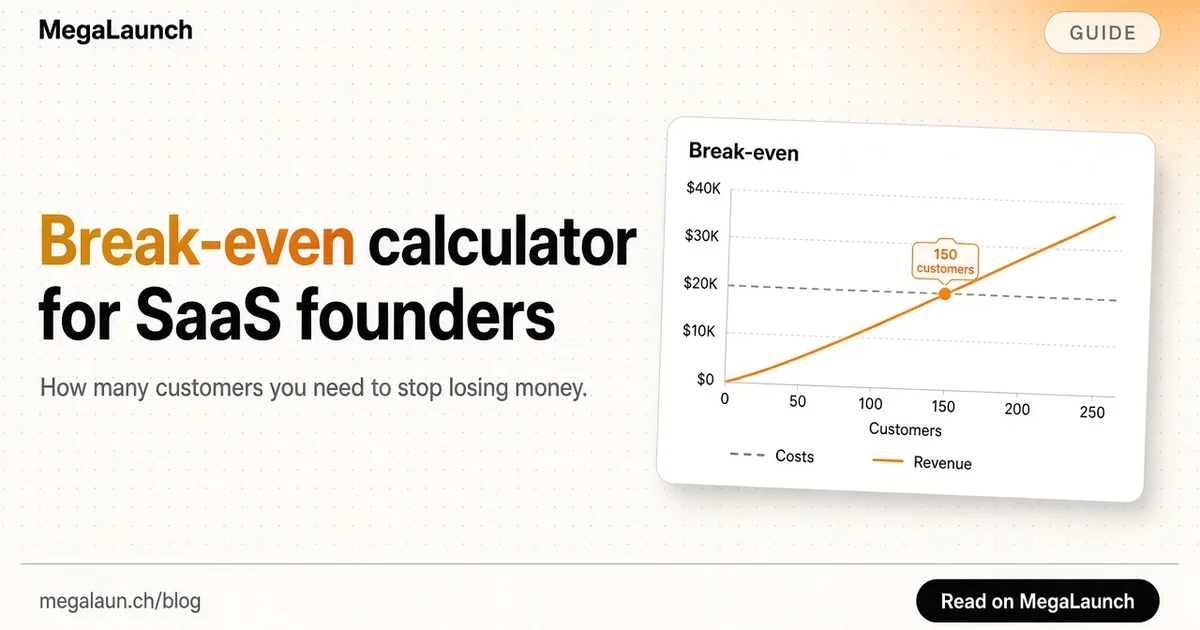
Break-even is the point where your revenue covers all your costs, so you stop losing money each month. For a founder, it is the line between needing outside cash and being able to keep going on your own. This guide gives you the break-even formulas, a simple calculator for a SaaS or digital product, a worked example and the levers that bring the break-even point closer.
In this article10
What break-even means
In economics, the break-even point is the level of sales at which total revenue equals total costs. Below it you make a loss, above it you make a profit.
To calculate it you need to split your costs into two groups:
- Fixed costs stay the same whatever you sell: salaries, contractors, software subscriptions, base hosting, accounting, rent, insurance.
- Variable costs grow with each customer or sale: card processing fees, per-user infrastructure, third-party API calls, support time, affiliate commissions.
The break-even formulas
Contribution per customer
Contribution = price - variable cost per customer
This is what each customer leaves you to pay fixed costs. It is called the contribution margin.
Break-even in customers (or units)
Break-even customers = fixed costs / contribution per customer
Break-even in revenue
Contribution margin ratio = contribution / price
Break-even revenue = fixed costs / contribution margin ratio
For a subscription business, run the calculation monthly: monthly fixed costs, monthly price and monthly variable cost per customer. The result is the number of paying customers you need at any time, not a one-off sales total.
A simple break-even calculator
Rebuild this in a spreadsheet:
| Cell | Input | Example value |
|---|---|---|
| A | Monthly fixed costs | $6,000 |
| B | Price per customer per month | $49 |
| C | Variable cost per customer per month | $9 |
| D | Contribution = B - C | $40 |
| E | Break-even customers = A / D | 150 |
| F | Margin ratio = D / B | 81.6% |
| G | Break-even revenue = A / F | $7,350 |
These are example numbers. With $6,000 of monthly fixed costs and $40 of contribution per customer, you need 150 paying customers, or $7,350 of monthly recurring revenue, to break even. Check: 150 x $49 = $7,350.
When will you reach break-even?
The break-even point tells you where the line is. The next question is how long it takes to cross it.
Months to break-even = (break-even customers - current customers) / net new customers per month
Net new customers means new paying customers minus cancellations. In the example, if you have 60 customers today and grow by 10 net customers a month, you need (150 - 60) / 10 = 9 months.
Two things make this estimate more honest:
- Use net growth, not signups. If you add 15 customers and lose 5, net growth is 10.
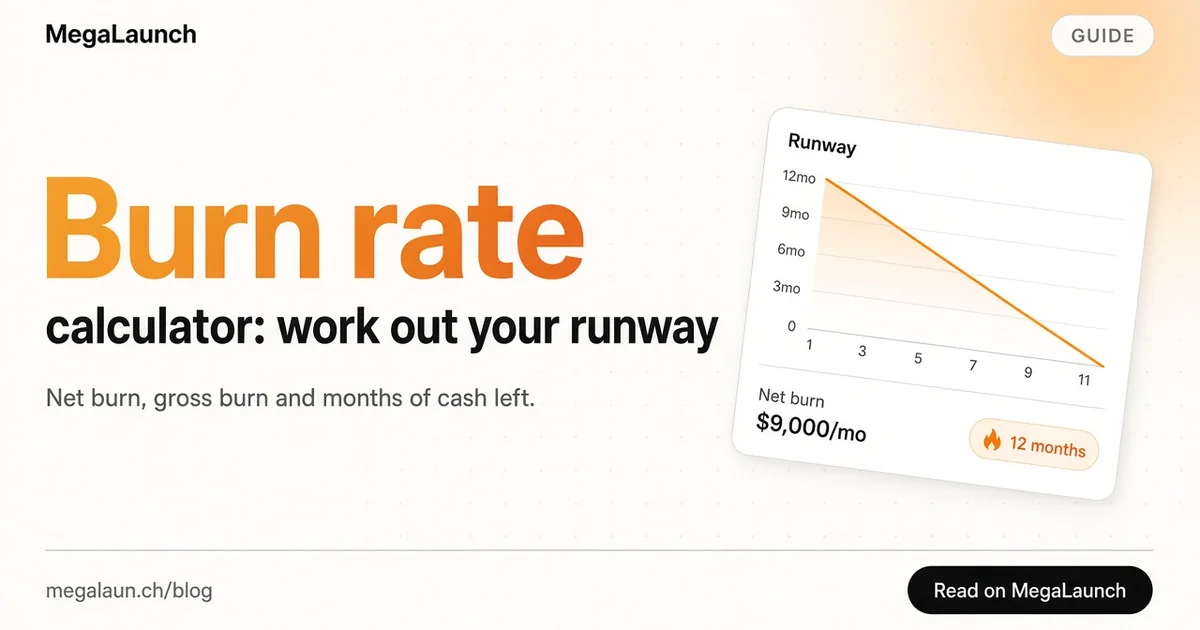
- Compare it with your runway. If break-even is 9 months away and you have 6 months of cash, you need to change something now. Our burn rate calculator guide shows how to work out runway.
Pay yourself in the calculation
Many indie founders calculate break-even without their own salary. The product looks profitable, but the founder is subsidizing it with unpaid time.
Run two versions:
- Business break-even: fixed costs without founder pay.
- Founder break-even: fixed costs including a modest salary for each founder.
In the example, adding $3,000 a month of founder pay raises fixed costs to $9,000 and break-even to 225 customers. Paul Graham calls the point where a startup covers the founders' living expenses ramen profitable: it does not make you rich, but it removes the pressure to raise money.
Three levers to lower the break-even point
The formula shows exactly what moves the number.
1. Raise the price
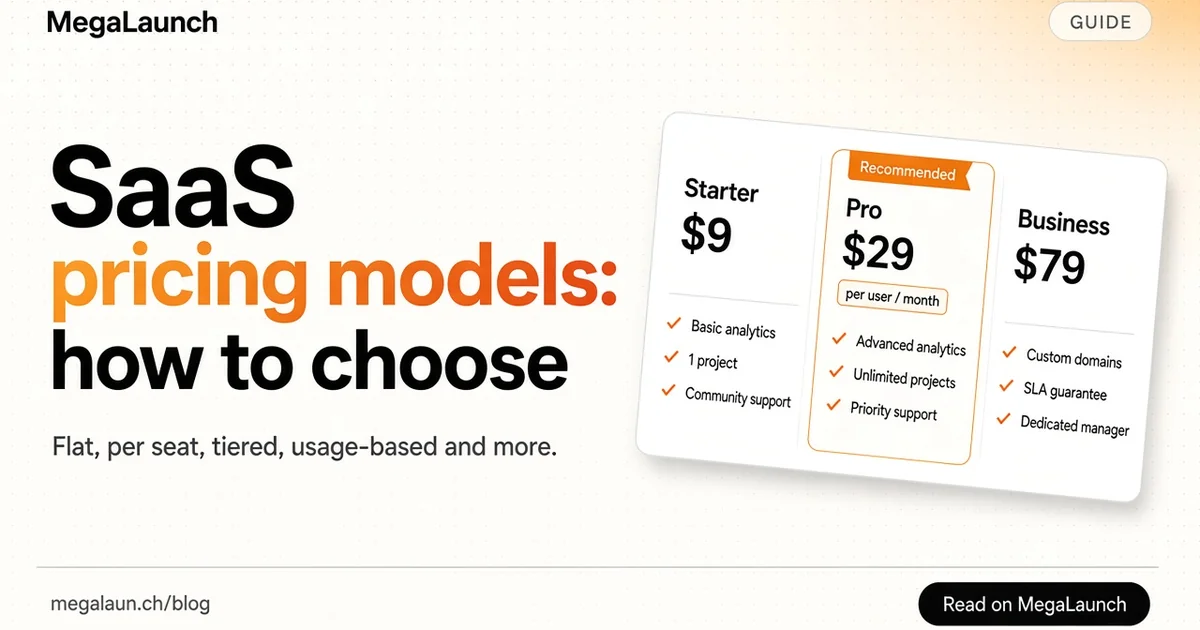
Price has the biggest effect because the variable cost stays the same. In the example, going from $49 to $59 raises contribution from $40 to $50 and cuts break-even from 150 to 120 customers, 20% fewer. If you are unsure about pricing, see our guide to SaaS pricing models.
2. Lower variable costs
- Cache or batch expensive API calls.
- Put usage limits on each plan so heavy users do not destroy your margin.
- Use annual plans to reduce the number of card transactions and fees.
3. Cut or delay fixed costs
- Cancel tools nobody uses; review subscriptions every quarter.
- Use usage-based or free tiers for infrastructure until you need more.
- Hire freelancers for one-off work instead of adding permanent salaries.
Break-even and customer acquisition
The basic formula ignores the cost of winning customers. If you spend on ads or sponsorships, include marketing as a fixed monthly budget, or add the acquisition cost per customer to the picture: each new customer then needs a few months of contribution before it pays back its own acquisition.
This is why cheap acquisition channels matter so much before break-even. Launch platforms, directories, content and communities cost mostly time, so every customer they bring moves you toward the line without raising fixed costs.
Sensitivity: test the uncertain inputs
Your inputs are estimates. A quick sensitivity table shows which one matters most. Cost-volume-profit analysis is the formal name for this kind of reasoning.
| Scenario | Fixed costs | Price | Variable cost | Break-even customers |
|---|---|---|---|---|
| Base | $6,000 | $49 | $9 | 150 |
| Higher price | $6,000 | $59 | $9 | 120 |
| Higher API costs | $6,000 | $49 | $14 | 172 |
| Founder salary | $9,000 | $49 | $9 | 225 |
Example numbers again. Round customer counts up, because you cannot have part of a customer.
Common mistakes
- Treating all costs as fixed. On AI products, model costs can be the biggest variable cost.
- Forgetting taxes and fees. Card fees, currency conversion and marketplace commissions reduce contribution.
- Ignoring churn. You need to replace cancelled customers before growth counts.
- Calculating once. Update the sheet every month with real numbers.
Break-even is a simple formula, but used every month it becomes a plan: you know how many customers you need, how long it should take and which lever to pull first.
Frequently asked questions
How do you calculate the break-even point?
Divide fixed costs by contribution per unit, which is price minus variable cost per unit. With $6,000 of monthly fixed costs, a $49 price and $9 of variable cost, break-even is 150 customers.
How do you calculate break-even revenue?
Divide fixed costs by the contribution margin ratio, which is contribution divided by price. In the example, $6,000 divided by 81.6% gives $7,350 of monthly revenue.
How long will it take to break even?
Subtract your current customers from the break-even number and divide by net new customers per month, meaning new customers minus cancellations.
Should founder salary be included in break-even?
Calculate it both ways. Without founder pay you see whether the product covers its own costs; with a modest salary you see when the business can actually support you.
Sources
 @matthias_mrc
Put it into practice. Launch your product.
A permanent page, a followed link to your site, and makers who vote for what they like.
- Free with a link back to MegaLaunch
- Premium: $14.99 one-time, no backlink needed
Done for you
We submit your product to 100+ dofollow directories.
From one brief, with a report for every directory. No badge needed on your site.


From$99one-time
See the plans