Product launch plan: a 6-week template for founders
A practical product launch plan template for indie makers and small SaaS teams: what to do 6 weeks before launch, on launch day and in the 2 weeks after, with owners, dates and a readiness checklist.

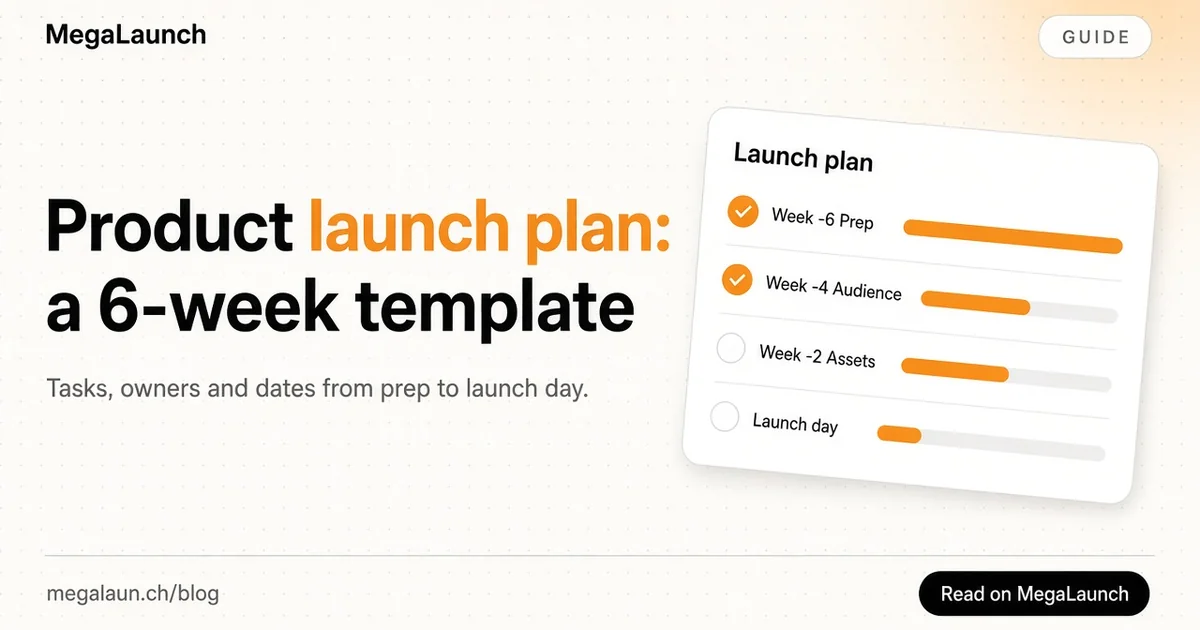
A product launch plan turns "we should launch soon" into a list of tasks with owners and dates. Without one, solo founders and small teams tend to ship the product, post once on social media and wonder why nothing happened. This template covers the six weeks before launch day and the two weeks after, with what to do in each phase and how to know you are ready.
In this article7
What a product launch plan is (and is not)
A launch plan is the operational side of your product launch strategy. The strategy answers who the product is for, what problem it solves and which channels reach those people. The plan answers what has to happen, in what order, by when, and who does it.
In the classic new product development process, launch is the last stage, and it is the one small teams most often improvise.
It is not a full go-to-market strategy document. For an indie product, one page with dates is enough. The goal is to remove decisions from launch week so you can spend it talking to users instead of writing copy at 2 a.m.
Before you start: three inputs
Write these down before planning tasks:
- One target user. A role and a situation, for example "freelance designers who send invoices every week". Every asset in the plan speaks to this person.
- One launch goal with a number. Signups, paying customers, waitlist conversions or replies. "Get 100 signups in the first week" is a goal you can plan backwards from. "Get visibility" is not.
- A launch date. Pick a real date, avoid major holidays and big industry events, and tell at least one other person so it stays fixed.
If you are not sure the product solves a real problem yet, launch a smaller version first. A minimum viable product with ten engaged users teaches you more than a polished product with none.
The 6-week product launch plan template
Copy this into a spreadsheet or task board with four columns: task, owner, due date, status. A simple Gantt chart view helps if several people are involved, but a list sorted by date works for a solo founder.
Week -6: foundations
- Write the positioning in one sentence: product, user, main benefit.
- Set up analytics and a way to count your launch goal (signups, trials, payments).
- Create the landing page with a clear headline, a screenshot or short demo and one call to action. If the product is not live, use a coming soon page with an email form.
- List every channel you will use, with the date you plan to post on each.
Week -5 and -4: audience
- Start collecting emails or a waitlist. Even 50 interested people change launch day.
- Share progress where your users already are: communities, newsletters, X or LinkedIn. Show the problem and what you are building, not only the product.
- Contact 10 to 20 potential users personally and offer early access. Paul Graham's essay Do Things That Don't Scale explains why this manual work matters so much early on.
- Note the questions people ask. They become your FAQ and your landing page copy.
Week -3 and -2: assets
- Write the launch announcement, the email to your list and the posts for each channel. Our guide to the product launch email has a structure you can reuse.
- Prepare visuals: 3 to 5 screenshots, a logo in square format, a short demo video or GIF.
- Prepare listings for launch platforms and directories: name, tagline, description, category, links. Write them once and adapt.
- Fix the top problems early users reported. Do not add new features now.
Week -1: dry run
- Test the full signup and payment flow on desktop and mobile, with a fresh account.
- Schedule what can be scheduled, such as the email and directory submissions.
- Prepare short replies for common questions and objections.
- Block your calendar for launch day and the day after.
Launch day
- Publish in the order you planned, starting with the channel that matters most.
- Reply to every comment and email within an hour or two. Engagement on launch day is part of the launch.
- Post a short update mid-day with something real: a first customer, feedback, a fix you shipped.
- Track the goal number in one place, not across ten dashboards.
Launch platforms are worth including: a community like Show HN suits technical products, and a launch platform such as MegaLaunch gives your product a public page and visibility with makers and early adopters.
Week +1 and +2: follow-up
- Email everyone who signed up and ask one question: what made you try it?
- Talk to at least five new users. Write down the exact words they use.
- Share results publicly if you are comfortable, including what did not work.
- Keep submitting to relevant directories and newsletters. Launch traffic fades, but listings keep sending visitors and links.
How to assign owners and dates
For a solo founder, the owner of every task is you, so the useful part is the date. Work backwards from launch day and give each task a deadline at least two days before it is needed.
With a small team, give each task one owner, never "everyone". Keep the plan in a shared document and review it in a 15-minute check every week. Mark tasks as done, late or dropped. Dropping a task on purpose is fine; forgetting it is the problem.
Common mistakes in launch plans
- Launching to nobody. If you have no list, no community and no contacts, launch day will be quiet. Build the audience in weeks -5 and -4.
- Too many channels. Three channels done well beat ten done badly. Choose the ones where your target user already spends time.
- Building during launch week. New features add bugs at the worst moment. Freeze the product a week before.
- No follow-up. Most of the value comes after launch day, from conversations and repeated small launches.
- No goal number. Without one you cannot tell whether the launch worked or what to change next time.
How to know you are ready
You are ready to launch when:
- The signup or purchase flow works end to end for a new user.
- The landing page explains what the product does in under 10 seconds.
- Your announcement, email and posts are written and checked.
- At least a few people outside your team know the date and plan to try it.
- You can measure the launch goal.
If one of these is missing, move the date by a week rather than launching blind. A plan is useful because it shows you what is missing before launch day, not after.
Frequently asked questions
How far in advance should you plan a product launch?
For an indie or small SaaS product, about six weeks is enough: two for foundations and audience, two for assets, one for a dry run, plus two weeks of follow-up after launch day.
What should a product launch plan include?
A target user, a launch goal with a number, a date, a list of tasks with one owner and a due date each, the channels you will use and the order you will publish on them.
Can a solo founder use a launch plan?
Yes. Every task is yours, so the useful part is the dates: work backwards from launch day and set each deadline at least two days before the task is needed.
What if I am not ready on the launch date?
If the signup flow, landing page, announcement or measurement is missing, move the date by a week. Launching blind usually wastes the attention you worked to build.
Sources
 @matthias_mrc
Put it into practice. Launch your product.
A permanent page, a followed link to your site, and makers who vote for what they like.
- Free with a link back to MegaLaunch
- Premium: $14.99 one-time, no backlink needed
Done for you
We submit your product to 100+ dofollow directories.
From one brief, with a report for every directory. No badge needed on your site.


From$99one-time
See the plans