SaaS examples: real products by category and model
Clear SaaS examples by category (collaboration, design, finance, analytics) and by pricing model, plus micro SaaS examples from indie makers and what they have in common.

SaaS, or software as a service, is software you use through a browser or app while the company runs it on its own servers and charges a subscription. You probably use a dozen SaaS products every day without thinking about it. Looking at clear SaaS examples, by category and by business model, is one of the fastest ways to understand what makes this model work and where an indie maker can still find room.
In this article7
What counts as SaaS
Wikipedia defines software as a service as a model where software is licensed on a subscription basis and centrally hosted. Three traits show up in almost every SaaS product:
- Hosted by the vendor. You do not install or update anything on a server yourself.
- Recurring payment. Monthly or yearly subscriptions, sometimes combined with usage fees.
- Shared infrastructure. Most SaaS products serve many customers from one system, an architecture called multitenancy, which keeps costs low as the customer count grows.
Software you buy once and install yourself is not SaaS, even if it has an online account. Neither is a pure marketplace that earns only a commission on sales.
SaaS examples by category
Communication and collaboration
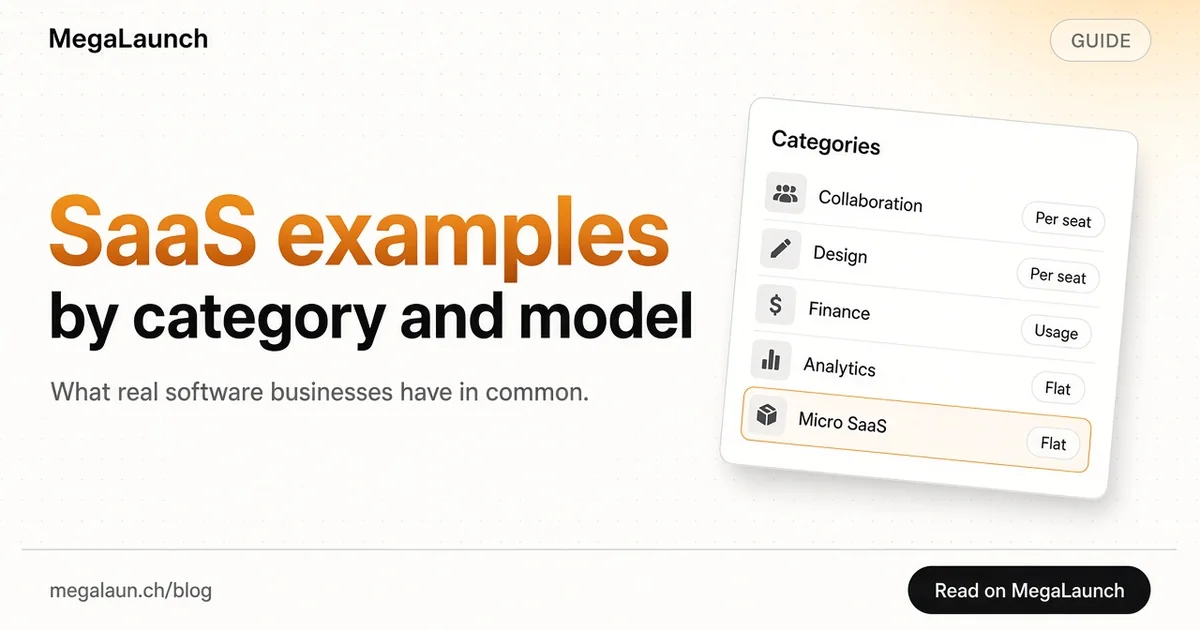
Slack, Microsoft Teams and Zoom are SaaS tools most teams know. They charge per user, so revenue grows as the customer's team grows. Collaboration tools were among the first SaaS products to spread inside companies one team at a time.
Project management
Basecamp is a well-known example of a project management SaaS run by a small, profitable company. Asana, Trello and Linear sit in the same category with different approaches: some charge per seat, others offer flat plans.
Design
Figma showed that even heavy creative software can run in the browser. Because files live in the cloud, several people can edit the same design at once, which is hard to do with installed software. Canva brought the same model to non-designers.
Documents and knowledge
Notion, Google Workspace and Dropbox store documents and team knowledge in the cloud. Many of them use freemium: a free plan for individuals and paid plans for teams that need admin features.
Sales and marketing
Salesforce is the classic example of SaaS for sales teams and one of the companies that made the model mainstream. HubSpot, Mailchimp and many smaller email and CRM tools follow the same pattern: a monthly plan tied to the number of contacts or seats.
Finance and payments
Stripe, QuickBooks Online and Xero handle payments, accounting and invoicing. Payment tools often mix subscriptions with usage pricing, such as a fee per transaction.
Analytics and developer tools
Plausible is an open source, privacy-friendly web analytics SaaS. It is a useful example for indie makers: a focused alternative to a giant product, sold on a simple monthly subscription. GitHub, Vercel and Supabase are SaaS for developers, usually with generous free tiers and paid plans based on usage.
SaaS examples by business model
The same category can be run very differently. When you study SaaS examples, look at how they charge, not only what they do.
| Model | How it charges | Typical examples |
|---|---|---|
| Per seat | Price per user per month | Slack, Linear, Figma |
| Tiered flat rate | Fixed price per plan | Basecamp, many indie tools |
| Usage-based | Price per unit used | Stripe, cloud and API products |
| Freemium | Free plan plus paid upgrades | Notion, Canva, Trello |
Our guide to SaaS pricing models compares these options in more detail and explains how to choose a value metric.
Micro SaaS examples from indie makers
You do not need a big team to run a SaaS. Many profitable products are built by one or two people who serve a narrow audience well. Browse the Indie Hackers products directory to see real examples with self-reported revenue, from simple form builders to niche tools for podcasters, agencies or online stores.
The patterns are consistent:
- A narrow audience. "Scheduling for yoga studios" rather than "scheduling for everyone".
- One painful job done well. Fewer features, better results on the main task.
- A clear alternative. Many micro SaaS products are cheaper, simpler or more private versions of a large tool.
- Distribution built early. The founder writes, builds in public or launches in communities before the product is finished. See our guide to build in public.
What these SaaS examples have in common
Across categories, successful SaaS products share a few habits worth copying:
- They solve a repeating problem. Subscriptions only make sense when the customer needs the product every week or month.
- They show value fast. Good onboarding gets a new user to a first result in minutes.
- They grow with the customer. Pricing tied to seats, usage or contacts means revenue rises as the customer succeeds.
- They keep customers. Low churn matters more than fast signups, because each month a customer stays adds revenue at little extra cost.
- They make leaving costly in a fair way. Data, templates and team habits build up inside the product over time, so switching takes effort even when a competitor is cheaper. The best products earn that loyalty with steady improvements rather than lock-in tricks.
How to use these examples for your own idea
Pick two or three SaaS examples close to your idea and study them as a customer would:
- sign up and note how long it takes to reach a first result
- read their pricing page and identify the value metric
- read recent reviews to find complaints you could solve
- check how they describe themselves in one sentence
Then write down what you would do differently for a specific audience. That difference is your positioning, and it is what you will test with your first users. When you have something people can try, our product launch strategy guide covers how to get it in front of them, and you can list it on MegaLaunch to reach other makers and early adopters.
Frequently asked questions
What are some examples of SaaS?
Common examples include Slack, Zoom, Notion, Figma, Basecamp, Salesforce, HubSpot, Stripe, QuickBooks Online, GitHub and Plausible Analytics.
Is Netflix a SaaS?
Netflix is a subscription streaming service rather than business software, so it is usually called a subscription or media service, not SaaS, even though it shares the subscription model.
What is a micro SaaS?
A micro SaaS is a small software-as-a-service business, often run by one or two people, that serves a narrow audience with a focused product and a simple subscription.
What is the difference between SaaS and regular software?
With SaaS, the vendor hosts and updates the software and you pay a recurring fee. With traditional software, you buy a license and install and maintain it on your own machines.
Sources
 @matthias_mrc
Put it into practice. Launch your product.
A permanent page, a followed link to your site, and makers who vote for what they like.
- Free with a link back to MegaLaunch
- Premium: $9.99 one-time, no backlink needed
Done for you
We submit your product to 100+ dofollow directories.
From one brief, with a report for every directory. No badge needed on your site.


From$99one-time
See the plans