SEO for SaaS: a plan for founders without an agency
SEO for SaaS without an agency: one search intent per URL, a quality gate before indexing, an honest sitemap, structured data and pages worth linking to.

In this article11
Does SEO work for SaaS?
Yes, because people look for software by typing their problem, the tool they want to leave, or two products they are comparing. Each of those searches can have a page on your site that answers it, written from what only you know: how the pricing works, what setup involves, where the product stops.
It is also slow. Google’s SEO starter guide says some changes take effect in a few hours and others could take several months. Set SEO up early and leave it running next to channels that bring visitors this week, such as a launch. MegaLaunch is a young site, so this article describes what we built, not traffic we can show you. Every Google, IndexNow and Ahrefs statement below links to its source, read on October 31, 2026.
When we pulled the US results on October 31, 2026, five of the eight organic results for “saas seo” came from agencies that sell SEO services, and the top result for “seo for saas” was a Reddit thread in r/SaaS asking how to start with SEO. This plan is the do-it-yourself answer: the sequence a small product site can run, taken from the code behind megalaun.ch.
What a SaaS SEO agency sells, and what you can run yourself
An agency sells hours of research, writing and outreach, some of it worth buying later. None of it is magic: Google’s page Do you need an SEO? says no one can guarantee a #1 ranking on Google, and lists the questions to ask a provider. Learning the basics first is how you tell a good proposal from a bad one.
What a founder can run alone is the structure: which page answers which search, which pages get indexed, how search engines hear about new pages, what the markup says, and what on the site is worth a link. These decisions sit close to the code and outlast any campaign. Here they are in the order MegaLaunch made them.
SaaS SEO strategy, step 1: one search intent per URL
List the searches you want to answer and group them by intent. Two queries share an intent when one page would satisfy both, which usually shows when their results are nearly the same pages. Each group gets one URL. Keep the map in a spreadsheet: query, intent, URL, and the date you checked the results.
The harder part is enforcing it. MegaLaunch had blog articles on Product Hunt alternatives and AppSumo alternatives, then built alternatives pages that answered those searches better. Each old URL now returns a permanent redirect to its replacement, from one list in the code, and the blog refuses to publish an article at a moved address again. A first-launch article was merged into the launch checklist with the same kind of permanent redirect.
Google treats a redirect as a strong signal that its target should become the canonical URL, and a sitemap entry as a weak one (consolidate duplicate URLs). For a page that has moved for good, it recommends a permanent server-side redirect, a 301 or a 308 (redirects and Google Search). This article follows the rule too: indexing, followed links, Domain Rating and programmatic SEO get one paragraph each here and a link to their own article.
Step 2: let a page into the index only when it stands on its own
A product site generates pages from its data: categories, tags, comparisons, archives. Most of them start thin. MegaLaunch writes a threshold for each type into the code and applies the same rule to the page’s robots tag and to the sitemap. A category hub is indexed from five published products. A tag page needs five products and a tag from a reviewed vocabulary. The Hall of Fame waits for ten final daily podiums. An alternatives page needs 1,200 words of analysis and five verified alternatives, a comparison page 1,000 words and a complete table of facts. Below its threshold, a page stays online with noindex, follow, and is left out of the sitemap.
Google’s spam policies describe scaled content abuse as generating many pages mainly to manipulate rankings rather than to help users, however the pages are made. To keep a page out of Google, use noindex: Google says robots.txt is not a mechanism for that (introduction to robots.txt). Keep robots.txt for crawl rules; the free robots.txt generator writes one from a form.
That threshold is what most programmatic SEO guides skip: they teach templates, not which generated pages deserve the index. The programmatic SEO article covers it in full.
Step 3: an honest sitemap, plus IndexNow
Google mainly finds pages through links from pages it has already crawled (SEO starter guide). A sitemap helps with the rest, without guaranteeing that every URL in it is crawled or indexed (sitemaps overview). List only the pages you want indexed, so the sitemap never contradicts your robots tags, and date entries honestly: Google ignores priority and changefreq, and uses lastmod only when it is consistently and verifiably accurate (build a sitemap). MegaLaunch dates a comparison page by its last update, never older than its newest fact check, and gives no date to pages without a meaningful one.
IndexNow covers the engines that support it: you post a changed URL once, and the IndexNow FAQ says it is shared with every participating engine, with no promise of immediate indexing. Its list of engines includes Bing, Yandex, Seznam, Naver and Yep, and not Google. MegaLaunch pings it from production when a Free listing goes live, when a listing is republished after its link back is restored, and when an article is published. For Google, verify the site in Search Console and submit the sitemap. How to submit a website to search engines covers indexing step by step.
Step 4: structured data that describes what the page shows
Structured data tells search engines what a page is: an article and its author, a list, a software application and its price. Google recommends JSON-LD when your setup allows it (introduction to structured data). On MegaLaunch, every article carries BlogPosting or Article markup with its author, comparison pages add an item list, breadcrumbs and their FAQ, and product pages describe the product as a SoftwareApplication.
Mark up only what the page shows and what you can back. Google’s software app result needs a price and a rating or a review, and Google does not guarantee that features using structured data will appear (software app structured data). MegaLaunch only knows one price for sure, zero for a product with a free tier, so a paid product gets neither a price nor a rating in its markup rather than an invalid item. Google also stopped showing FAQ rich results on May 7, 2026 (Search Central updates). We still mark up our FAQs, because the markup describes the page.
The free schema markup generator checks the fields Google requires as you type, the FAQ schema generator handles a list of questions, and the SERP simulator previews your title tag and meta description before you publish.
B2B SaaS SEO: comparison pages built on sourced facts
B2B buyers compare. Searches such as “X alternatives” or “X vs Y” come from people choosing a tool, close to a decision, and a comparison written by one of the products in it is suspect from the first line.
MegaLaunch’s alternatives pages and comparisons are built so a reader can check every line. Each fact about another platform is stored with the URL it was read on and the day it was checked, the source list prints those dates, and the page says who publishes it and what MegaLaunch sells. Each page says when the other option is still the right choice, and gives a corrections address: Matt applies a correction within seven days and updates the check date.
Google’s guide to creating helpful content asks whether a page provides original information, reporting, research or analysis. A dated table of facts you checked yourself does, even on a small site. A reworded feature list does not.
SEO for startups: give other sites something to link to
A new domain has few links, and links are how search engines find pages. You can ask for them, or build things people cite unprompted. MegaLaunch’s free tools are that bet: small utilities that run without an account, most of them tied to the article that explains their job. A tool earns a link when it saves someone a step they would otherwise explain in their own post.
Not every link is treated the same way. Google generally does not follow links whose rel attribute contains nofollow, ugc or sponsored, and asks for paid placements to be marked sponsored (qualify your outbound links). The dofollow backlinks article explains what “dofollow” means in practice and how to check a link yourself.
Domain Rating is Ahrefs’ own score from 0 to 100, on a logarithmic scale, not a Google metric (Ahrefs on Domain Rating). It is a reasonable filter when you choose where to get listed, and a poor goal for your own site. What is a good Domain Rating? explains how to read it.
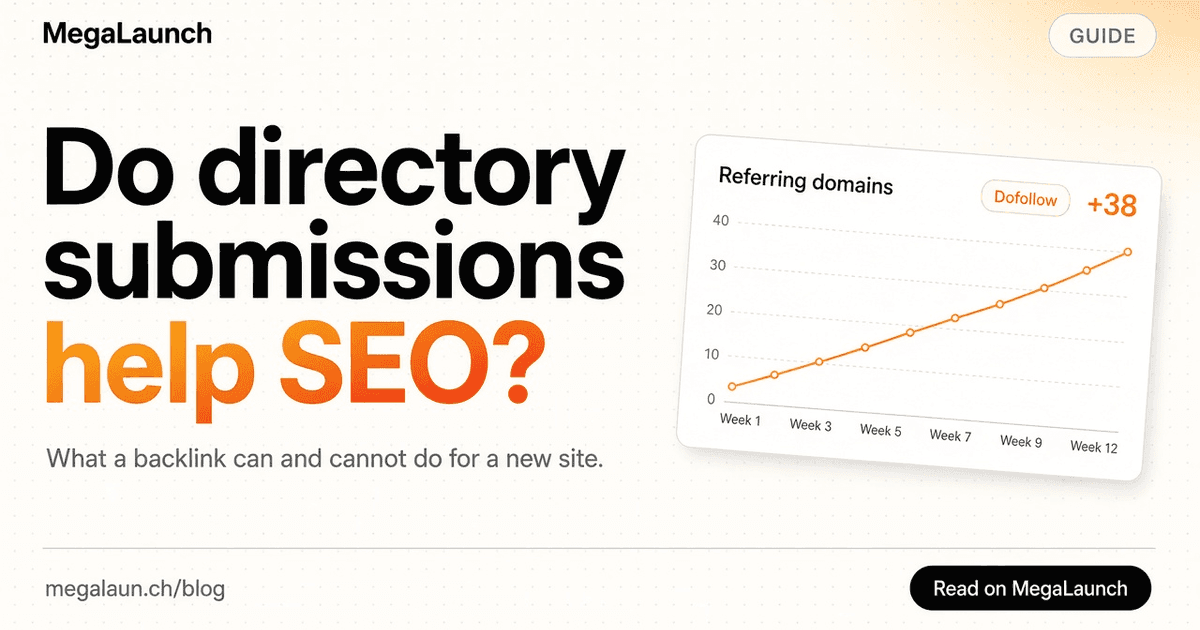
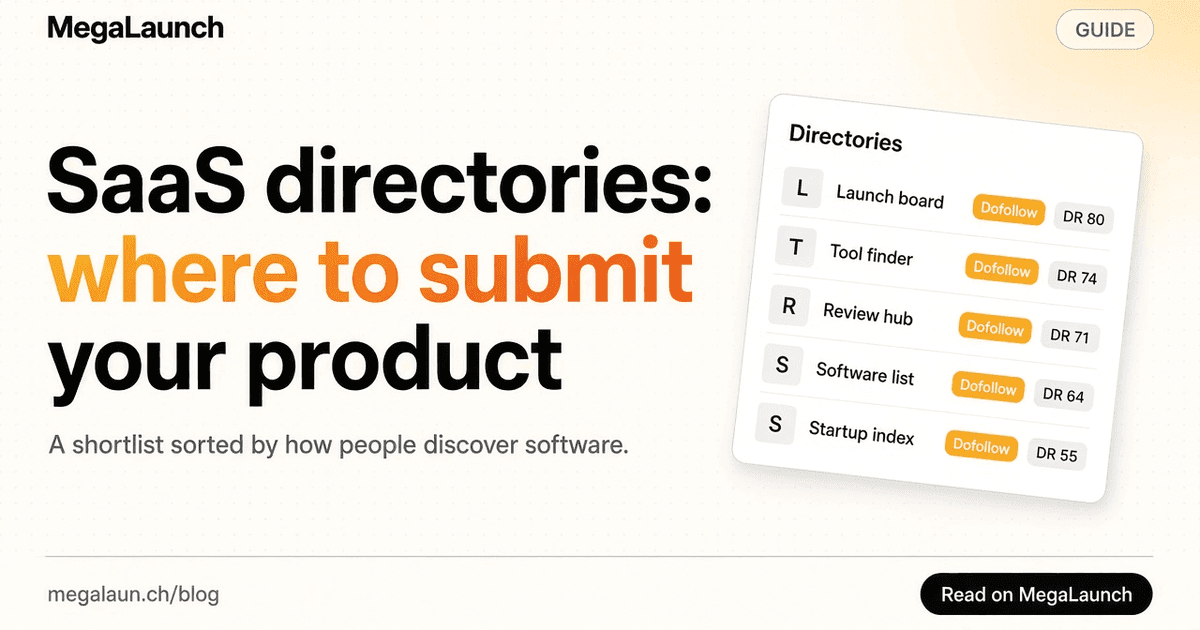
For a new product, the first links usually come from launch platforms and directories. Pick the ones your buyers browse: do directory submissions help SEO? explains what to check, and free backlinks for a new website covers other methods. On MegaLaunch, a Free listing goes live 48 hours after your submission, once we have checked your link back to MegaLaunch, and its link to your website carries no nofollow or sponsored attribute. If you would rather not fill in the forms, our directory submission service submits your product by hand to 100+ directories in one-time plans (Starter $99, Growth $149 and Mega $199), with a report for each directory, and promises no rankings, traffic or Domain Rating.
How to create an SEO strategy for a SaaS product: the first month
Starting from zero, this is the order we would follow, at roughly one row a week for a founder working on it part time: structure first, then content, then links.
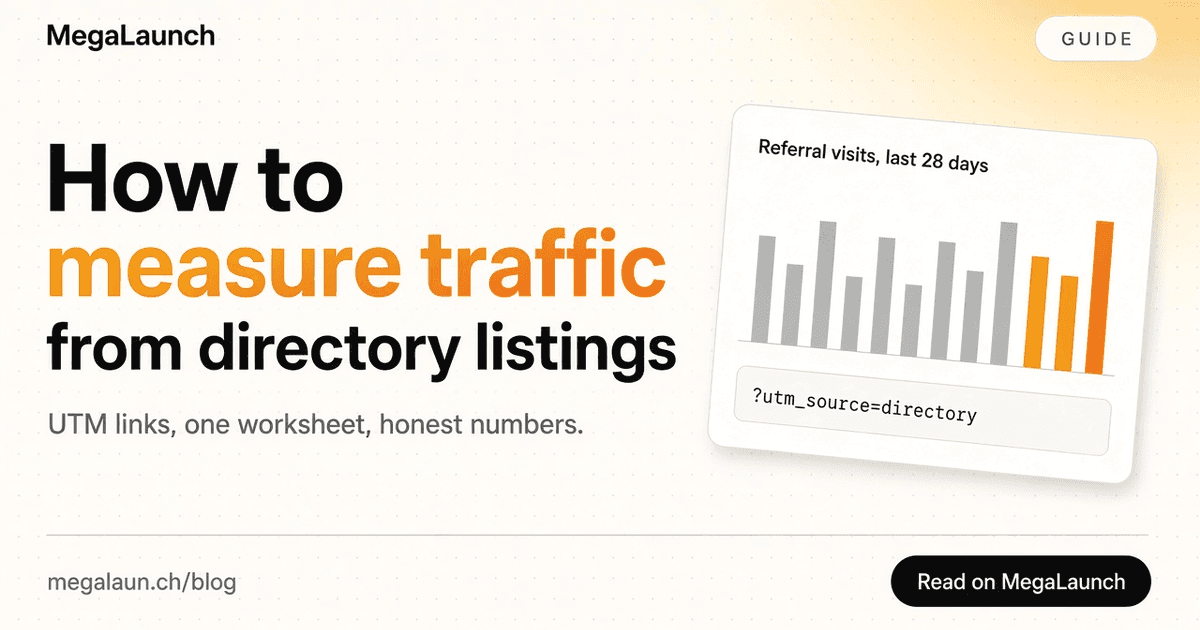
Measure with what you control. Search Console’s Performance report shows how your pages perform in Google results. Tag each link you place yourself with the UTM builder so its visits stay separate, and keep a worksheet like the one in how to measure traffic from directory listings. Note what you changed and when, so a movement in the report has a likely cause.
| Week | Do this | Done when |
|---|---|---|
| 1 | Verify the site in Google Search Console and Bing Webmaster Tools, submit the sitemap, list the searches you want to answer and group them by intent. | Every target search has one URL in your map. |
| 2 | Fix what exists: one title and meta description per page, a redirect for each duplicate, noindex on thin generated pages. | The sitemap lists only pages you want indexed. |
| 3 | Add structured data per page type, then write or rewrite the page closest to a purchase, often a comparison. | The markup matches the visible page and every claim has a source. |
| 4 | Ship one free tool or dataset others can cite, and get your first relevant listings. | Each listing link is tagged and recorded in your worksheet. |
A suggested order for a solo founder, not a promise of results. The routine continues after the first month.
Where SEO fits in your SaaS marketing
SEO is one channel of a plan, and a slow one. It works best beside a channel that brings people this week, such as a launch, a community or direct outreach. The SaaS marketing strategy article helps you choose two channels and give them time, and the go-to-market strategy template puts search content next to your other channels on one page. When a page stops being true, fix it or redirect it the same week.
Frequently asked questions
Do I need a SaaS SEO agency?
Not to start. The structure in this plan is work a technical founder can do, and an agency can add writing volume or outreach later. Ask the questions in Google’s Do you need an SEO?, and walk away from anyone who guarantees a #1 ranking, which Google says no one can.
Is SEO still worth it with AI Overviews?
Google says there are no additional requirements or special optimizations to appear in AI Overviews or AI Mode, and that SEO best practices remain relevant to them (AI features and your website). The plan in this article is the same plan.
Is PPC better than SEO for a startup?
They do different jobs. Paid search can bring visits from the first day and stops when the budget stops. SEO takes months to start and can keep bringing visits after the work is done. On a small budget, a little paid search shows which queries bring buyers, and SEO pages can then target those queries.
Should a new SaaS start with programmatic SEO?
Only once you have data that makes each page genuinely different, and a rule for which generated pages are good enough to index. Without both, you risk the thin pages Google’s spam policies call scaled content abuse. The programmatic SEO article covers the thresholds.
Do directory listings help a SaaS rank?
They can give a new site its first links and referral visitors when the directory is one your buyers browse. They do not guarantee indexing or rankings. Check each listing link with the dofollow checker and judge the directory by the visitors it sends.
Sources
- Google Search Central: SEO starter guide (checked October 31, 2026)
- Google Search Central: Do you need an SEO? (checked October 31, 2026)
- Google Search Central: consolidate duplicate URLs (checked October 31, 2026)
- Google Search Central: redirects and Google Search (checked October 31, 2026)
- Google Search Central: spam policies, scaled content abuse (checked October 31, 2026)
- Google Search Central: introduction to robots.txt (checked October 31, 2026)
- Google Search Central: sitemaps overview (checked October 31, 2026)
- Google Search Central: build a sitemap (checked October 31, 2026)
- IndexNow: participating search engines (checked October 31, 2026)
- IndexNow: FAQ (checked October 31, 2026)
- Google Search Central: introduction to structured data (checked October 31, 2026)
- Google Search Central: software app structured data (checked October 31, 2026)
- Google Search Central: latest updates, end of FAQ rich results (checked October 31, 2026)
- Google Search Central: creating helpful, reliable, people-first content (checked October 31, 2026)
- Google Search Central: qualify your outbound links (checked October 31, 2026)
- Ahrefs: Domain Rating (checked October 31, 2026)
- Google Search Central: AI features and your website (checked October 31, 2026)
- Search Console Help: Performance report (checked October 31, 2026)
Free tools mentioned in this article
- Robots.txt GeneratorBuild a readable robots.txt file with path rules and sitemap URLs, ready to copy or download.
- Schema Markup GeneratorJSON-LD for seven schema types, checked against the fields Google requires as you type, ready to copy and test.
- FAQ Schema GeneratorTurn your questions and answers into FAQPage JSON-LD you can paste into your page.
- SERP SimulatorCheck your page title and meta description length, with a search-style snippet and a social card preview.
- UTM BuilderAdd UTM parameters to any link, one at a time or one per directory in bulk, with a clean lowercase convention.
- Dofollow CheckerInspect links to your website in a public page and see their rel attributes and page nofollow rules.
 @matthias_mrc
Put it into practice. Launch your product.
A permanent page, a followed link to your site, and makers who vote for what they like.
- Free with a link back to MegaLaunch
- Premium: $4.99 one-time, no backlink needed
Done for you
We submit your product to 100+ dofollow directories.
By hand, with a report for every directory. No badge needed on your site.


From$99one-time
See the plans