
Do directory submissions help SEO?
Understand directory submissions, backlinks and Domain Rating. Learn what to check before buying a service and how to evaluate the result without hype.
In short: A relevant directory can provide a useful route to your product. A submission count, a high DR or a paid placement does not guarantee indexing, rankings or customers.
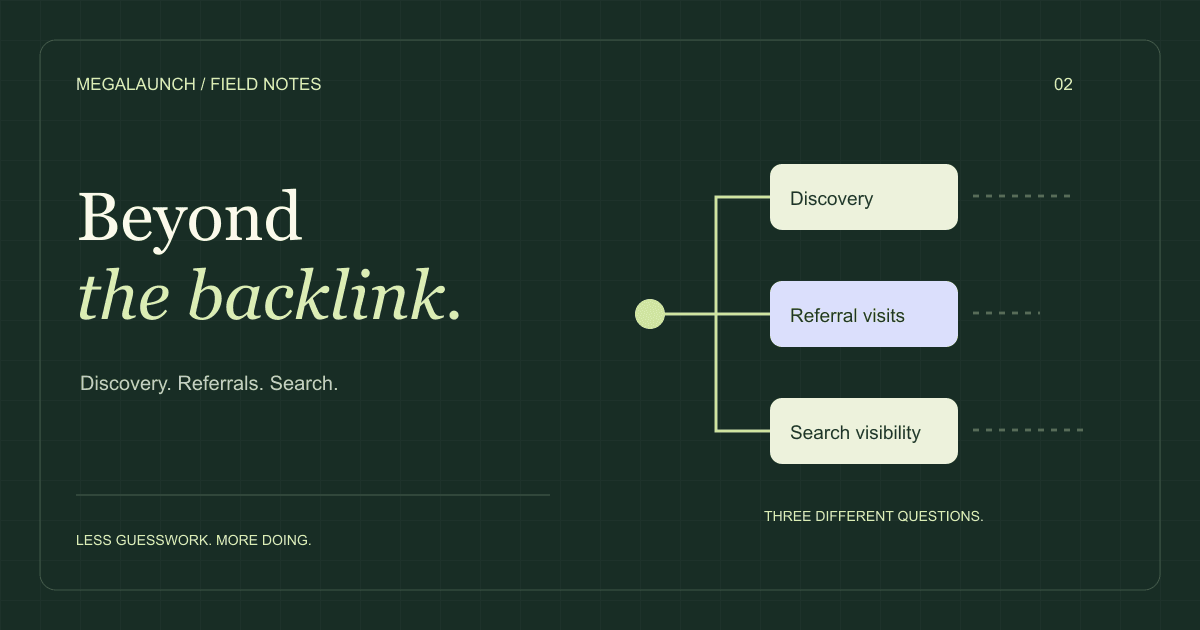
Separate discovery, referral traffic and search performance
Directory submissions are often sold as one outcome, but they create several things you should evaluate separately. A listing can help a person understand a product. Its website link can send a visitor to your site. A search engine may discover or evaluate a page that links to you. None of those events proves the next one happened. Begin with separate questions so a report full of listing URLs does not become an unsupported claim about business growth.
Imagine a niche directory sends five people who all need the workflow you built. Another sends a hundred people who are simply browsing new tools. Which result is more useful depends on what they do next. The first might produce conversations that improve your onboarding. The second might reveal an unclear promise on your landing page. Looking only at the number of backlinks or visits would hide both stories.
For an early product, a sensible first objective is to create accurate, relevant ways to be found and then observe what happens. Write down the product’s existing search visibility, recent referral visits and a meaningful action in the app before beginning. Keep dates beside every measurement. That baseline will not turn a small campaign into a controlled experiment, but it gives you a more honest comparison than memory or a screenshot taken on an unusually good day.
What a backlink tells you, and what it does not
A backlink is a link from another website to yours. Inspect the actual link and the context around it rather than relying on a label in a sales card. Is it attached to the correct product? Does it lead to the intended page? Can a visitor understand what they will find? Does the directory describe the current product accurately? These are checks you can perform directly without a paid SEO tool.
Google documents link attributes including sponsored, ugc and nofollow. Paid advertising links should be appropriately qualified. Google also lists low-quality directory links and links created mainly to manipulate rankings among link-spam examples. Those policies are a reason to focus on useful placements and accurate disclosure instead of purchasing a promised ranking signal. The linked Google documentation below is the primary reference, rather than a vendor’s interpretation of its own offer.
Ask a supplier to separate the work they control from the decisions they do not. Preparing a description and sending a submission are tasks. Acceptance, editorial wording, publication dates and link treatment belong to the receiving directory. You can agree on a reporting format for those outcomes, but you cannot make them certain by putting them in a spreadsheet. A transparent report can include a rejection and still accurately document the work performed.
Use Domain Rating as context, not a promise
Ahrefs Domain Rating, or DR, is Ahrefs’ metric for the strength of a website’s backlink profile relative to other sites in its database. It is a third-party metric, not a Google score. It describes a domain-level link profile, not the commercial value of one listing or the likelihood that your next visitor will become a customer. The source and date matter whenever you quote the number.
Keep the questions separate in your own worksheet. One column can hold measured DR with a timestamp. Another can describe audience fit. A third can record the actual listing page and its status. If a directory has an impressive domain score but no relevant category, write that mismatch down. If a small niche site is closely aligned with your customers, do not erase that evidence because its domain score is lower.
Avoid converting DR into an invented forecast. There is no useful basis for telling yourself that ten directory submissions will add a fixed number of DR points or generate a fixed amount of revenue. When someone offers that kind of guarantee, ask how the result is measured, over what period and under whose control. A concrete deliverable, such as a checked listing with a working link, is easier to verify than a broad authority promise.
Check the receiving page and your destination page
Start with the page a reader will actually use. Open the listing without being signed in. Check that the product name is correct, the description is readable and the main link works on a phone. Follow that link and complete the first action you expect a visitor to take. If they need an account, verify that the sign-up path is understandable. An attractive listing cannot compensate for a destination that does not load or explain the product.
For your own website, confirm that the pages you want found are public and intentionally indexable. Keep the canonical URL consistent and remove accidental development-only noindex rules before a launch. Use a clear page title, a useful description and links between related pages. These are maintenance tasks to check, not a guarantee of rankings. If you are unsure about the implementation, make a short issue list and resolve the obvious problems before expanding distribution.
Google states that a crawl request does not guarantee indexing. A directory accepting a submission does not change that limitation. Keep “submitted,” “published” and “observed in search” as distinct states in your records. Record the date of the observation rather than assuming it happened when the page went live. This makes your next review more useful and prevents a supplier’s activity report from becoming your own unsupported search-performance report.
- Listing: public, correctly named, readable and linked to the intended website.
- Destination: usable on mobile, with a working route to the product.
- Metadata: a specific title, an accurate description and a consistent canonical URL.
- Indexing: check the settings and observations separately from publication status.
Ask for evidence that matches the service
Before purchasing managed submissions, ask to see the structure of the final report. Useful fields include the directory name, submitted URL, submission date, current status, listing URL when available and any action the founder needs to take. If paid listing fees are included, ask which ones are covered by the package. If there is a completion window, distinguish submission work from the receiving sites’ review timelines.
Define how duplicates and existing listings will be handled. A product may already appear on a directory under an older name or URL. Creating another page can leave customers looking at conflicting information. A sensible workflow records the existing page and checks whether it can be updated or claimed. Keep account credentials out of shared reports. A report needs to show the work, not distribute access to every account involved.
Use a small acceptance checklist for the service you bought. Did the report arrive? Are the rows understandable? Do available links point to the correct product? Are unresolved items visible? These questions are deliberately different from “Did my rankings go up?” You can assess fulfillment when the agreed work is complete, while continuing to measure referral and search outcomes over time. Combining the two too early makes both conversations harder.
| Evidence | What it supports | What it does not prove |
|---|---|---|
| Submission confirmation | A form or request was received | Editorial acceptance |
| Public listing URL | A product page is available | Indexing or qualified traffic |
| Recorded referral visit | A visitor reached your website | A new customer |
| Search performance trend | An observed change over time | That one listing caused the change |
Evaluate the campaign without inventing causality
Review a campaign in layers. First check the records of work. Then look at referral visits and meaningful actions. Finally, look at search observations over a longer period, alongside other changes to the product and website. A new article, a release, a social post and a directory launch can overlap. Keep a simple changelog so you remember what else happened before attributing every movement to one supplier.
When a small sample produces no obvious result, be precise about what you know. “We observed three visits and no completed demos this week” is useful. “Directories do not work” is a broader conclusion that the sample may not support. Likewise, one new paying customer does not prove a repeatable acquisition channel. The next decision can be a limited second experiment, a better landing page or stopping that particular placement.
If your immediate need is a single product page, MegaLaunch offers a free listing and a one-time Premium launch, described on the pricing page. Neither option is a directory submission run, and neither guarantees rankings. Choose the work that matches your next question, keep the evidence and revisit the decision when you have enough information to learn from it.
Set a review owner as well as a review date. A solo founder can use a short weekly note: what was published, what was corrected, what visitors did and what will change next. A team can assign that note to one person while keeping the source records shared. This is a practical way to keep a campaign accountable without pretending that a dashboard can explain every change in discovery.
Track referral traffic from your directory listings · Understand free and paid product launches · Compare the Free and Premium launch options
Sources


